

Rusty broken metal chain on an old wooden workbench
Tetelestai Recovery

Overcome Addiction: A Progressive Approach

Rusty broken metal chain on an old wooden workbench

The Tetelestai Recovery Series is a collection of faith-based addiction recovery books written by Marc and Lori Ridenour. Rooted in the biblical declaration “It is finished” (John 19:30), the series offers a faith-based approach to finding lasting freedom from addiction and emotional healing. 

Available in Paperback, Kindle, and Audiobook formats.


Volume 1: Tetelestai Recovery: It is Finished
Introduces the core concepts of the series. It targets suffering addicts, chronic relapsers, and their loved ones. The authors provide evidence for permanent sobriety by focusing on Christ’s ultimate healing rather than traditional struggle.

You can browse this volume on Amazon.


Volume 2: Our New Normal
Focuses on the often awkward and overwhelming early stages of sobriety. This book guides readers through identifying and resolving emotional and social dysfunctions, helping them navigate fears and resentments.

https://a.co/d/04079fyX


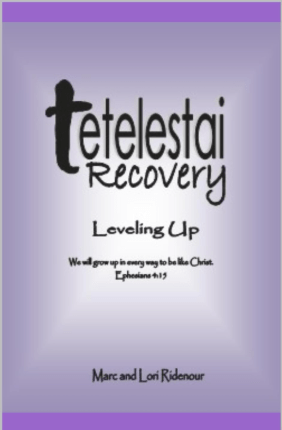
Volume 3: Leveling Up
A lifeline designed to assist individuals in achieving long-term, lasting victory over any addiction to reach their full potential. 

https://a.co/d/06VM8Qz1


Group of people gathered around a campfire in a cave with a beam of light shining from above
Tetelestai Recovery

Healing Together: The Power of Community in Crisis

There are four hundred strangers who come to David in that cave. Sacred text lists their only credentials as ‘in distress, in debt, and discontented.’ Our 12-step friends would call them restless, irritable, and discontented.

All those who were in distress, or in debt, or discontented gathered around him and he became their leader. About four hundred men were with him. (1 Samuel 22:2)

This passage proves the value of support groups. When we find ourselves restless, irritable and discontented, we gather with others in similar struggles, to share experience, strength, and hope.

The men who gather with David in his cave have nothing to lose. They are broke, busted, and disgusted. But David calls them holy. God carefully hand-selected these individuals who would be known for all time as David’s Mighty Men of Valor.

As we gather in our cave of collective defense mechanisms and dysfunctional behaviors, we find a common bond. We identify our ‘isms and use the declaration of Christ, “It is finished!” to call an end to our fears. For way too long, our caves made us feel safe and protected from our trauma. But in those caves, our ‘isms are hidden. Coming out of the cave means our ‘isms will be exposed, and we will have to face our fears.

David wrote Psalm 142 while hiding, waiting, and healing in a cave. His final verse tells of being released from captivity. We join with him in this request to be released from our own caves. We need freedom from addictions, dysfunctional behaviors, character defects, personality disorders, pessimism, perfectionism, and all those other toxic ‘isms which keep us from our true purpose.  

Set me free from my prison so that I may praise your name. Then the righteous will gather around me because of your goodness to me. Psalm 142:7

Dining table with Christmas decorations, wine bottles, glasses, and place settings
Tetelestai Recovery

Navigating Emotional Turmoil in Family Relationships

We find that nothing spotlights our dysfunctions quite so vividly as when family shows up to help! Granted, it is a blessing to have family who care enough to show up, but we also know the risk. For those of us, whose tendency is to shut down emotionally when family dynamics are in play, our emotions become glitchy and start to malfunction. We say the wrong thing, blurt out secrets, wear the wrong clothes, belong to the wrong social groups, and vote for the wrong candidate.

It has been said that family is everything. Families can teach us about loyalty, behavior, and self-preservation. They can teach us work ethics and responsibility. Families also teach us how to be manipulative, sarcastic, and selfish. All families have their own layers of drama, chaos, and distrust.

Some families are quite ordinary. Some families are quite extraordinary. All families have dysfunctions, traditions, trauma, and mixed messages.

Family members know too much about each other and the history they all share. Family can push our buttons like no one else. Family can make us feel included or rejected; loved or despised; powerful or weak. Although family dynamics are messy, they are God’s plan for a place to start. Unfortunately, each generation has an ancestry made up of humans, so we all possess some elements of dysfunction within our family code…

Person walking alone on a winding country road at dusk with bare trees around.
Tetelestai Recovery

Confronting Self-Sabotage: Breaking the Cycle

When we run from our dysfunctions, we are ill-equipped for what is in store for us. We seem to find ourselves facing one crisis after another. Often, we walk right into them as if we planned it that way. Self-sabotage is something we practice on a regular basis but really don’t understand why.

No matter where we go, conflict soon follows. As it turns out, our self-defense techniques are portable. We carry them from one relationship to another; one job to another; one church to another. We are searching for the perfect hideaway. We hope someday our dysfunctions will magically disappear and we will never see them again. But time after time, we are hit head-on with a new threat to our well-being and those same dysfunctions rear their ugly heads again…

Person hiking on mountain trail with wildflowers and distant mountains
Tetelestai Recovery

Understanding Tests: Patience as a Path to Growth

Person hiking on mountain trail with wildflowers and distant mountains

When caught up in a moment of testing, we must resist letting our feelings and circumstances serve as a litmus test for our faith. It is not healthy, nor is it accurate.

Tests are for the express purpose of developing patience. Whether the tests come from internal or external forces, they have a purpose. Some of the tests we face are due to our own weaknesses and might easily become our demise, but even then, God always has a better plan. Any test that activates patience is beneficial. Guilt and blame serve no purpose.

Patience tells us that tests are only temporary. Patience tells us that God is doing a good work in us, and He will complete it. Patience tells us not to judge our walk by one random stumble. Patience keeps us steady as we wait for the storm to pass.

It is patience that we lack when we throw up our hands and give up. It is patience that we lack when we question our progress. It is patience that will get us to the finish line. It is patience that will help us be gentle with ourselves.

Sometimes, our tests are random and spring up like a pop quiz. Other times, an ominous test looms far in the future, and we struggle to avoid it. However, considering our passage from James, we need not avoid tests. They all have a purpose; even the ones we fail. If the test teaches us to be patient, with ourselves, with God, or with another human being, we have passed. With God, we are always in a win-win situation.

Our tests are to develop patience. The work of patience is to develop perfection. There is no fast track from one to the other. Each test takes time. That’s where patience does its work.

Winding mountain road with cars and sun rays breaking through dark clouds
Tetelestai Recovery

Finding Joy in Trials: Embracing Life’s Challenges

Winding mountain road with cars and sun rays breaking through dark clouds

When the roads are easy, we feel joy in looking back to see how far we’ve come. When the roads are difficult, we seem to take one step forward, two steps back. Sometimes we slip and fall. Sometimes we just stand still and shrug. Even when we do finally get on firm footing again and start to move forward, we scold ourselves for not being stronger, more resilient, or more determined.

We aren’t sure what to call these moments of uncertainty. The word ‘backsliding’ seems way too judgmental. The last thing we need is to feel more isolated and cut off from God than we already do.

One evening without notice, a moment of grace fell on our Friday night group. One member shared a passage from the book of James. It altered our perspective about these irritating, uninspiring days when we are simply putting one foot in front of the other.

My brethren, count it all joy when you fall into various trials, knowing that the testing of your faith produces patience. But let patience have its perfect work, that you may be perfect and complete, lacking nothing. James 1:2-4

Add flowers and lush green meadows
Tetelestai Recovery

Unlocking Your Potential: A Path to Spiritual Inheritance

As it turns out, perfection doesn’t have anything to do with stopping bad habits, attending church, or memorizing scriptures. Perfection is about becoming like our Father. Loving toward all, even those who don’t deserve it, treating everyone the same, whether friend or foe, and praying for those with whom we struggle. It requires a huge investment, but it also promises a big payout.

We are perfect now, just like the tiny green tomatoes are perfect. We have great potential. The fulfillment of our potential, however, is contingent on how willing we are to set aside personal feelings or judgements toward others and treat them like our Father does.

This effort does not go unrewarded. Pure perfection is our spiritual inheritance. It is who we are, and it is where we are going.

Carrying a grudge and getting even is often considered a power move that gives one the upper hand. But as we level up, we must weigh the cost of personal vendettas against the value of our own perfection potential. We must realize that feuds and hostilities are just too costly. Nothing is more appealing than living up to our full potential. We want so much to be like our Father that no one, not even our enemies, can prevent us from being kind.

A bright glowing ember sits on rocky ground inside a dark cave
Tetelestai Recovery

I’m Here Because It Wasn’t Safe There

In 1 Samuel 22, we read about David, the would-be king who is making decisions clouded by dysfunction. The story begins with rejection, danger, and drama. David is at risk. He has experienced trauma. He is out of his element, all alone, and without clear direction. His life has come down to a series of geographical moves and his only reason is simple, “I am here because it was not safe there.”

These words ring true for us as well. We have experienced trauma. In response, we run, we tell lies, we act crazy, and in the end, we finally find a cave where we can hide.

We enter our caves carrying something that makes us feel fierce. We carry memories of times when we weren’t so weak. Despite our insecurities and weakness, we also know there is resilience, tenacity, and charisma woven into our DNA by the Creator of the Universe.

In David’s story, he had the sword of Goliath strapped to his side, reminding him of his greatest victory. But, later, after experiencing his own trauma, it seemed his glory days were over. He is hiding in a cave which he refers to as his stronghold. Battling anxiety, depression, and loss, the cave becomes a makeshift fort for David and his absent army. Bringing an abrupt end to his promising career, his entire future has been destroyed by one man. The grief was too much to bear. The man who once killed a giant with a rock, got hit between the eyes with trauma and it took him to a dark place. Everything changed. Nothing would ever be the same. He is alone. He is unprepared. He is in self-defense mode, and his behavior becomes irrational and unpredictable…

Ripe and unripe tomatoes growing on a garden vine tied to a wooden stake.
Tetelestai Recovery

How Babies and Tomatoes Teach Us About Perfection

People commonly use the word perfect to describe a newborn baby. Babies are inadequate in every way. They are unable to feed themselves, walk, read, or even roll over. Sometimes they cry or make messes. Yet, we say they are perfect. Every stage is perfect and necessary in the process of transitioning to the next stage.

A tiny green tomato on the vine is a perfect tomato, although it does not have the color, flavor, or texture of a fully ripened tomato. The tiny green fruit is perfect, but it is not yet useful for its intended purpose. If it remains on the vine, the perfect green tomato will grow into its full potential. And throughout each stage of its growth, it will continue to be perfect.

Thus, we conclude that perfection is about potential. Perfection has little to do with current behavior or ability, but a lot to do with our mindset. Perfection is a state of being which maintains continuous momentum toward progress…

A man in simple robes gently comforting a distressed older man on a dirt path with olive trees and stone buildings in the background
Tetelestai Recovery

Embracing Confidence in God’s Perfection

Being confident of this very thing, that he, who hath begun a good work in you, will perfect it unto the day of Christ Jesus.” Philippians 1:6

It feels wrong to say we are perfect. We aren’t quite sure how to align the character qualities of honesty and humility with such a bold statement. It seems like both a brag and a lie.

Yet, we believe in a God of faith, who “calls things that are not, as if they are” (Romans 4:17). His words make things happen and His words say we are being made perfect.

Therefore, if we remove the dimension of time, we can most assuredly say that somewhere in time, it has happened. Therefore, we step outside of time and claim it now. We call out what God has promised and continue declaring it until the truth becomes our reality…