
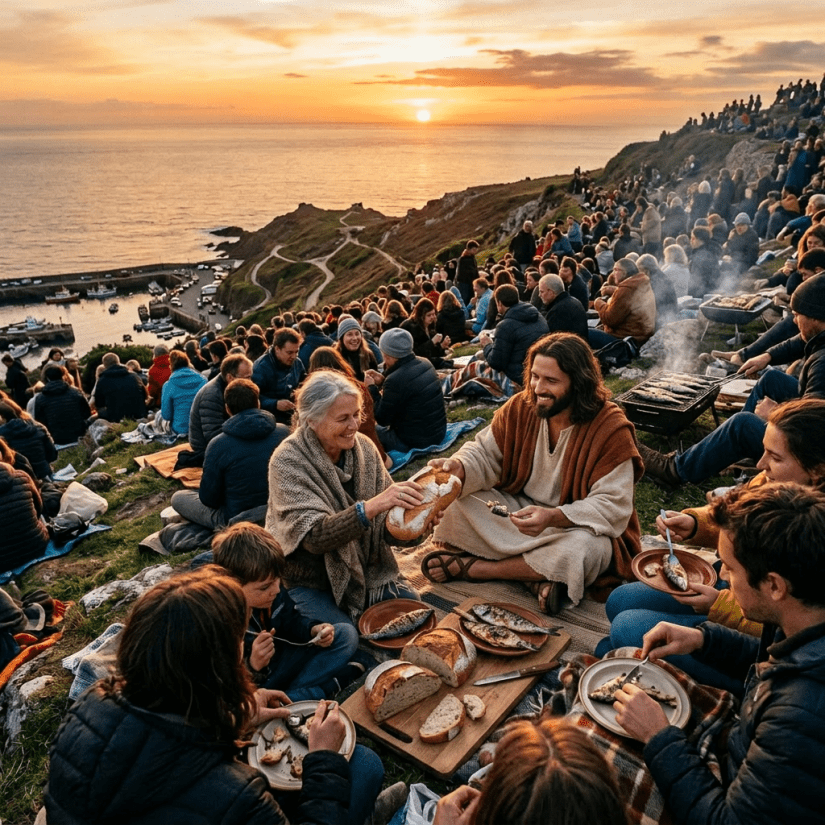
Group of people sharing food on a grassy hillside with ocean and sunset in the background
Tetelestai Recovery

Jesus’ Compassion: A Model for Our Needs

We see that during His mission on earth, Jesus never scolded anyone for asking too much or too often. In fact, He stated time and time again, “Just ask. I want to give you what you need. ”

The feeding of the five thousand demonstrated the Father’s heart through the acts and attitudes of His Son. Jesus had compassion on the famished crowd. He didn’t condemn them for being distracted by their growling stomachs. He didn’t belittle them for showing signs of weakness. He didn’t minimize their hunger by comparing it to His own when He fasted for forty days. It wasn’t His desire to see them suffer to prove their devotion.

They were hungry and He wanted them to be fed. Jesus met their needs abundantly. He provided more than enough. There may have been some who gave up and left early before the miracle arrived. This may account for the enormous number of leftovers His disciples collected after everyone was fed.

We realize it is critically important that we never become one who wanders away, feeling the pressure to fend for ourselves, rather than waiting to see what Jesus is doing.

We know there will be times of waiting. And during those times, we might not have a clear view of what is happening, or how the miracle will unfold, but waiting is part of the process, and we must become willing to put in the time…

A Date With Destiny

Help

Mark 9:27

But Jesus took hold of the boy’s hand and helped him to stand up.

****************

The Lord cares deeply about you and comes to your rescue whenever you ask for His help.

God sees that some of the things you go through are difficult. You know that help is required if you are going to be able to withstand the pressure and come through to the other side, unscathed.

With the calm reassurance of Jesus at your side, these struggles do not leave you weakened. Instead, you emerge from difficult predicaments with a newfound awareness of your position of power in Christ.

You sense His presence of with greater intensity during times when you are down and finding it impossible to stand on your own.  Because of this, you have learned to be grateful for your struggles, because they generate a new level of intimacy between you and your Savior.

Because you know He is there to carry the heaviness you feel after having been wronged, He enables you to move freely into forgiveness where healing can be found. 

Assured that the Creator of the universe is interested in what happens to you, and is willing to help whenever you ask, your confidence is solid and no earthly problem can shake it.

https://a.co/d/4a536Xc

Tetelestai Recovery

It’s a Choice

Considering whether or not God can actually forget our sins, leaves us with two important theological questions:

  • If God can forget things, then how can He be all knowing?
  • If God can’t forget things, then how can He say that He remembers our sins no more?

Forgiveness is extremely difficult for us, so we assume that it must be even worse for God because he is all present, all powerful, and all-knowing.

In our human relationships, we like to believe that the people we have wronged will gradually forget about it over time. But with God, we know that’s not an option because He exists outside of time. There is no movement of time in the spirit realm. He is everything, everywhere, all at once.

So, we have to ask ourselves, “How can God say that He forgives us and remembers our sins no more?” The answer is simple: He chooses not to remember.

Because He is God, he can make choices that are outside the bounds of human ability. With the attribute of omnipotence (all powerful), He can make the choice not to remember.

In Isaiah 43:25, God says, “I will not remember your sins.”

In Jeremiah 31: 34, “I will forgive their iniquity, and their sin I will remember no more.”

Hebrews 8: 12 and Hebrews 10:17, “Their sins and their lawless deeds I will remember no more.”

There is nothing to indicate God absentmindedly forgets, as if He suffers from dementia or it just slips His mind. Rather, in His infinite mercy, He chooses not to remember the wrongs that He has forgiven. Therefore, we conclude that surface level theology says, “God forgets,” while leveled-up theology says, “He chooses not to remember.”

Continue Reading https://a.co/d/et0BASS