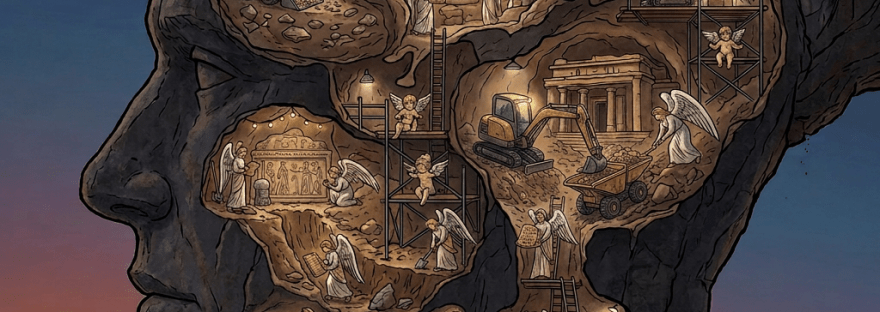

In matters of our recovery from substance addiction and the mental dysfunction that accompanies it, we were completely helpless. We had no thoughts that could heal our thoughts. We had no disclosure that could remove our secret shame. We had no detour that would lead us out of the darkness. We were lost. We were alone. We were afraid.
But suddenly, in a random, unexplainable moment, the gift of Tetelestai was revealed. We had run out of options, yet in that barren wasteland of emptiness, we stumbled upon a treasure trove of truth.
There is an overpowering conflict that occurs within the mind of anyone who has encountered the desperation of addiction. The struggle to escape one’s own mind by flooding it with toxic levels of mood-altering chemicals is the true definition of insanity. Yet many of us suffered from this fatal and debilitating disease, consenting to the madness as if there were no other option.
In search of total recovery, we discovered we were not only seeking to be delivered from our dependency on mind or mood-altering substances, but we also searched for freedom from our thought processes, our twisted perceptions, and our obsessive fears.
In this emotional state of chronic crisis, we were exhausted.
We struggled to be free from a mind that plotted its own demise. Our thoughts quite literally tormented us to the point of insanity. We needed a way to manage our feelings and silence our sickness…
We concluded that all humans suffer from at least one type of addiction. However, we also know that every addiction can be called out and destroyed, using the pronouncement of Jesus, “Tetelestai” (It is finished).
Last Word Recovery Ministries developed the Tetelestai Recovery program that is based on the power of Jesus declaration which offers the possibility of permanent freedom for anyone struggling with addiction.
As the ripple effect of this program began to reach the families and friends of those who were enjoying permanent sobriety, we received requests for an expanded version of the program which could address other destructive addictions and dysfunctions beyond the scope of drug or alcohol dependence. We were intrigued by this idea and excited to pursue it.
In this third volume, Tetelestai Recovery – Leveling Up, we address some non-drug addictions, along with other dysfunctional behaviors related to the human condition. We offer Sacred Text selections that can break these strongholds and prevent further harm.
Tetelestai Recovery is not just for addicts. It is for everyone. Jesus says, “It is finished!” to the behaviors and dysfunctions that weigh us down and hold us back.
Let your eyes look straight ahead, fix your gaze directly before you. Make level paths for your feet and take only ways that are firm. Proverbs 4:25-26
Make level paths for your feet, so that the lame may not be disabled, but rather healed. Hebrews 12:13
Both verses spoke of walking level paths which offer firm footing and stability. There was no demand to scale mountain ledges, hike over rocky terrains, lose ground on shifting sand dunes, or trudge through marshy swampland. We were not told to look down, closely examining each next step with caution because the journey was so treacherous. We were simply instructed to seek out level paths and keep our focus upward.
In other words, we had to stop making it harder than it needed to be. We were simply to ask God for direction and trust that He would deliver us to exactly the right place at exactly the right time. We simply needed to keep walking. One foot in front of the other. Forward motion. No fear. One step at a time. No looking down and no looking back.
The presence of unwanted feelings such as insecurity, inadequacy, fear, anger, and other social phobias, coupled with our inability to manage or control them, unleashed within us a desperation for relief at any cost. We soon learned of a temporary reprieve that occurred when our brain chemistry became altered. We didn’t care that the relief would be short lived or cause irreparable damage. The long-awaited relief of rightness, contrasted against the life-long agony of wrongness, offered such an enchanting embrace, we surrendered without a fight.
Without mind and mood altering substances, we fell into total despair. Sadly, these moments of disparity began to seep into every moment, and the temporary relief withdrew as quickly as it came.
We became slaves to our feelings. We tested the quality of our product by the way it made us feel. We watched for warning signs of overdose by the way our bodies felt. We discovered ways to get out of responsibilities by saying, “I don’t feel well.” We made all sorts of excuses to ourselves and to others, based on our feelings. We accused our dealer of cutting because his product didn’t make us feel the way we wanted, or the way it used to. We sank into despair when the supply ran out. We drove through blizzards, walked through storms, and did whatever necessary to get the substance that would make us feel right. We went without sleep, food, and basic necessities. We lost relationships and emptied bank accounts in a mad pursuit of a feeling we wanted to feel.
We were caught in a cycle of frenzied flight. Running from feelings we couldn’t stand. Searching for a feeling we thought we knew. We didn’t like to feel wrong, and we didn’t know how to feel right.
It was not enough for us to simply stop using mind or mood-altering substances. We needed something more significant. We began to suspect that our primary purpose in life was not simply to stay clean and sober. While sobriety was an honorable ambition, and one we had desired deeply for many years, we found that mere sobriety fell woefully short of the abundant life promised by Jesus. We began to believe that our truepurpose was to discover the reason for our existence.
We came to realize that sobriety was not the end goal. As it turned out, sobriety was simply a way of life we had grown to prefer, since clarity of mind was beneficial in our quest for true purpose...
To level up, we must acknowledge that every action starts with a choice. And every choice carries two equal and opposite decisions. In other words, every choice carries both a yes and a no decision.
If we say yes to sobriety, we say no to chaos and destruction. And visa-versa. If we say yesto a drink or drug, we say noto hope and sanity. When we say yesto thinking about our choices, we say noto making the same bad decisions, expecting different results.
When leveling up, we must accept our own responsibility for the choices and events of our lives. We must realize that our decisions, even in little things, matter. Whether it is getting a good deal on a laptop we suspect is stolen, or working the system to get benefits we don’t really deserve, every decision sets off a chain reaction of negative results and consequences.
We thought about our individual experiences with yes and no decisions, then shared them with the group.
One member who had been set free from an addiction to porn, shared his decision-making process when it comes to watching television. He knows which shows will trigger lustful thoughts, so he simply chooses not to watch them. He decides instead to watch sports, cooking shows, and science programs on PBS. He says yes to living free from shame which means he says no to shows that trigger him. Each time he makes that choice, he places himself in a position of power. He continues to pursue his destiny using the wisdom God has given. He is leveling-up into a mature, godly man who demonstrates great leadership skills.
Another member of the group shared about self-esteem issues. From childhood, he had been trying to cope with the confusion of trauma, unaware of what to call it. He struggled with feelings of unworthiness and was unable to feel a sense of value. That all changed when he made the choice to learn about trauma and its effects. He chose to develop a relationship with Jesus, his Healer. He made a choice to forgive and move away from the pain. Because he says yes to openness, and no to suffering in silence, he now operates in a position of influence and serves as an advocate for others. He has the wisdom of God and the heart of a servant.
When we catch ourselves feeling discouraged or ashamed, we simply ask, “Is this thought excellent and praiseworthy?” If it is not, we need to drop it.
As hard as it is for us to believe, we have more power over our thoughts than we ever imagined. We find it is perfectly fine to set a negative thought down. We don’t need to lug it around with us until we make sense of it. We aren’t required to analyze and over-think, searching for some secret solution hiding inside our rapid-fire scatter thoughts. We can just let go and let God.
Unhealthy thoughts are just that. Unhealthy. They can never help us level up. If a thought is not healthy, we can set it down and choose a healthier topic.
As it turns out, our thoughts are a lot like books in a library. If we happen to pick one out that isn’t good, we can just put it back and choose a better one.
Using the criteria listed in Philippians 4, while paying particular attention to the instructions following the word finally, we can select our thoughts with intention and precision. We don’t need to be saddled with thoughts that hold us down and hold us back. We are leveling up and need to clear our minds of the unproductive clutter.
As far back as we could remember, we felt different, damaged, and just plain wrong. We did not know exactly what was wrong with us. We only knew that we felt more intensely than others and we processed our problems with great difficulty.
We obsessively examined ourselves, looking for clues to solve the mystery and to find a key which would unlock some invisible door into normalcy. We noticed people we admired and made feeble attempts to imitate their personas. We sought out damaged friends who would validate us in our dysfunction. We pursued money to prove our worth. We questioned and we blamed. We fought with ourselves and resented God. We learned how to act right, but we didn’t know how to feel right. Eventually it was our feelings which became our undoing.