Sometimes, our tests are random and spring up like a pop quiz. Other times, an ominous test looms far in the future, and we struggle to avoid it. However, considering our passage from James, we need not avoid tests. They all have a purpose; even the ones we fail. If the test teaches us to be patient, with ourselves, with God, or with another human being, we have passed. With God, we are always in a win-win situation.
Our tests are to develop patience. The work of patience is to develop perfection. There is no fast track from one to the other. Each test takes time. That’s where patience does its work.
In the original language of the New Testament, the phrase “It is finished,” was translated from the Greek word Tetelestai. I was introduced to this word one day when I was well into my fourth year of permanent healing from addiction. I didn’t realize at the time that I was entering the phase of my recovery that would prove to be permanent.
It was through this word that I started to delve deeper into the power of the last words of Christ “It is finished.” I discovered the power of Tetelestai, during a year-long court battle which had been a residual consequence from my old life. The day I appeared in court to hear the verdict and receive my sentence, I claimed this scripture and the word Tetelestai over my case. I was relieved by the peace it held and became willing to accept whatever God had in store for me, even if it meant a year in prison.
I prayed this scripture and acknowledged the fact that God had already redeemed me. He had made me a new creation by healing me from addiction. As I was praying that morning, God was working on the judge. He gave the judge an insight into something that no one else had seen. To everyone’s surprise, he dismissed my case, and I walked out of there a free man.
We all knew that Jesus, my advocate, was at work in that courtroom. I also know that He delivered the insight into my judge’s mind around the same time my wife and I were praying that morning. When the verdict was given, it seemed as if Jesus said, “’It is finished! Let my servant, Marc get back to handling the work I’ve given him to do.”
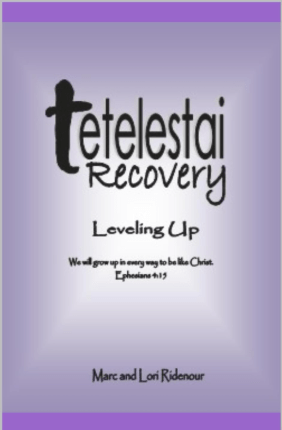
The Tetelestai Recovery Series is a collection of faith-based recovery books written by Marc and Lori Ridenour, based on their own experience with alcoholism and drug addiction. Rooted in the biblical declaration “It is finished” (John 19:30), the series offers a faith-based approach to finding lasting freedom from addiction and the emotional wreckage that accompanies it.
Available in Paperback, Kindle, and Audiobook formats.
Volume 1: Tetelestai Recovery: It is Finished Introduces the core concepts of the series. It targets suffering addicts, chronic relapsers, and their loved ones. The authors provide evidence of permanent sobriety by focusing on Christ’s ultimate healing rather than the traditional life-long struggle.
Volume 2: Our New Normal Focuses on the often awkward and overwhelming early stages of sobriety. This book guides readers through identifying and resolving emotional and social dysfunctions, helping them navigate fears and resentments.
Volume 3: Leveling Up A lifeline designed to assist individuals in achieving long-term, lasting victory over any addiction to reach their full potential.
We noticed that Jesus’ final word tetelestai, translated into the English phrase, it is finished, seemed to imply a sense of giving up. We found this to be an unfortunate language barrier. As it turns out, in the original Greek language of the New Testament, this word tetelestai is a declaration of victory, completion, and success.
Tetelestai is the comment an artist might whisper after completing his final brush stroke on a masterpiece.
Tetelestai is the report a soldier would bring to his commanding officer when a battle was over, and victory had been secured.
We believe our Savior used His final breath on the cross to declare for all time, to all creation, in every dimension, that there is nothing left undone: It is finished; Tetelestai.
There is no more drudgery to sobriety and no more anguish to recovery. There is no self-effort which must be added to what has been declared, Tetelestai.
The presence of unwanted feelings such as insecurity, inadequacy, fear, anger, and other social phobias, coupled with our inability to manage or control them, unleashed within us a desperation for relief at any cost. We soon learned of a temporary reprieve that occurred when our brain chemistry became altered. We didn’t care that the relief would be short lived or cause irreparable damage. The long-awaited relief of rightness, contrasted against the life-long agony of wrongness, offered such an enchanting embrace, we surrendered without a fight.
Without mind and mood altering substances, we fell into total despair. Sadly, these moments of disparity began to seep into every moment, and the temporary relief withdrew as quickly as it came.
We became slaves to our feelings. We tested the quality of our product by the way it made us feel. We watched for warning signs of overdose by the way our bodies felt. We discovered ways to get out of responsibilities by saying, “I don’t feel well.” We made all sorts of excuses to ourselves and to others, based on our feelings. We accused our dealer of cutting because his product didn’t make us feel the way we wanted, or the way it used to. We sank into despair when the supply ran out. We drove through blizzards, walked through storms, and did whatever necessary to get the substance that would make us feel right. We went without sleep, food, and basic necessities. We lost relationships and emptied bank accounts in a mad pursuit of a feeling we wanted to feel.
We were caught in a cycle of frenzied flight. Running from feelings we couldn’t stand. Searching for a feeling we thought we knew. We didn’t like to feel wrong, and we didn’t know how to feel right.
As far back as we could remember, we felt different, damaged, and just plain wrong. We did not know exactly what was wrong with us. We only knew that we felt more intensely than others and we processed our problems with great difficulty.
We obsessively examined ourselves, looking for clues to solve the mystery and to find a key which would unlock some invisible door into normalcy. We noticed people we admired and made feeble attempts to imitate their personas. We sought out damaged friends who would validate us in our dysfunction. We pursued money to prove our worth. We questioned and we blamed. We fought with ourselves and resented God. We learned how to act right, but we didn’t know how to feel right. Eventually it was our feelings which became our undoing.