This book is dedicated to the members of Tetelestai Recovery who meet every Friday evening in the Lansing Correctional Facility.
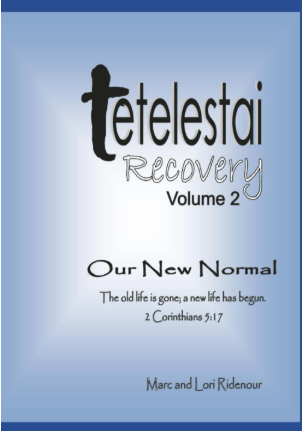
The profound insights and personal experiences shared between inmates and volunteers in this lively discussion group have been the inspiration for this sequel to the original Tetelestai Recovery text published in 2019: Tetelestai Recovery Finding Total Recovery in the Words of Christ, “It is Finished!”
Peace I leave with you; my peace I give you. I do not give to you as the world gives. Do not let your hearts be troubled and do not be afraid.
John 14:27
***********************************
Jesus gave us this promise of peace, translated from the original word shalom, meaning: wholeness; nothing missing; nothing broken. Therefore, if we failed to experience it, we needed to know why.
**********************************
Was He a liar? Did He tease us with hope and then pull it away like Lucy holding the football in the Charlie Brown cartoon?
We developed resentment toward this Higher Power who seemingly yanked away our hope, time after time. If He controlled the universe, why didn’t He just snap His fingers and make all our misery disappear?
We questioned Him and His ways. We saw other people receive deliverance and healing from their dysfunctions and we were jealous. We finally concluded that the odds of a miracle landing on us were about the same as a rose petal falling from the sky and landing on our heads.
We knew we couldn’t raise our hopes for a miracle of our own if it was simply a cosmic lottery. We were driven to figure out what we could do to make it happen. We had been taught all our lives that a person gets what they deserve. We feared our relapses and failures had deemed us unworthy.
We knew how to work in the natural realm to get what we wanted. We worked hard. We had built personal empires and seen our own efforts succeed in other areas of life. This made it extremely difficult to understand why we couldn’t succeed in our efforts to maintain consistent sobriety.
We wanted to work for recovery and thus, control the results. We wanted to work for it, so we could own it. We wanted to know we had earned our sobriety. We wanted to receive accolades for how courageous we had been. We wanted to know it had come to us honestly, through hard work and perseverance.
Tragically, we discovered that our work just didn’t work.
The upside-down declarations of a fallen world rang out loud and clear:
Trauma causes permanent damage.
Don’t get your hopes up or you will be disappointed.
Nothing gets better; everything is getting worse.
Life will kick you down.
You are growing more weak, frail, and overwhelmed.
The world’s message was abrupt and hopeless: The end result of life is death.
The inauguration of triumph within Christ’s victory cheer, “Tetelestai!” turned these statements right side up. Much like the development of a photograph from negative filmstrip, black became white, white became black, and color emerged, as the world was submerged in the bright red solution of Jesus’ blood.
The law was fulfilled, the curtain was torn, and the New Covenant eliminated the curse, opening the floodgates of blessing for all. The responsibility of the covenant rested solely on the finished work of Jesus. No more sacrifice could outperform the one which announced, “It is finished!” His declaration broke the curse and banished the old covenant of law. Blessings became contingent on Christ’s obedience rather than our own. We found within that realm of grace, the script was flipped, and hope was born.
For forty years, from the time Peter watched his Savior and friend leave this world, airlifted by a fanfare of angels, he had been on a journey of enlightenment. He had become painfully aware of just how upside-down this natural world really was. He had learned, through the power of the Holy Spirit, to walk in a supernatural existence, free from natural limitations. He personally encountered events in which prison led to freedom, death led to life, and sickness led to health. An angel had walked him out of a maximum-security prison. People were raised from the dead on his watch. Some were healed when his shadow passed over them. When Jesus told Peter he would be doing greater miracles that the ones he had seen his Teacher do, He wasn’t exaggerating!
Peter recognized this world for what it was: an upside-down creation waiting to be turned right-side-up. Peter walked upright for many years, against the grain, in an upside-down world where most people just didn’t get it.
We wondered if Peter realized the significance of his choice to die upside-down. From that perspective, looking out on his crowd of accusers, who appeared to be hanging by their feet to a dusty sky, he was given a glimpse of how distorted one’s viewpoint could be, when looking at things upside-down.
When Jesus was spotted by His friends, coming toward the boat, they first thought He was a ghost. He knew what they were thinking. Although they should have been relieved to see Him, they were, in fact, terrified instead. He saw the horror in their eyes and realized they weren’t recognizing Him for who He was.
We recall times when we were unaware that Jesus was approaching, and we became frightened by our own misperceptions. We saw death approaching, but in the end, it proved to be the Author of Life. The disciples thought they were seeing a ghost. And much like those young men, we too become afraid of what He represents. Some fear He will leave them. Others fear He will prohibit their self-expression. Some fear He will demand too much or create too much controversy. Many of us encountered a fear of Jesus, not fully understanding who He was or why He’d come.
Jesus comes to us in different forms. Sometimes He comes in the supernatural realm as an unmistakable tingle of the Great Spirit. Other times He approaches through the Presence of other addicts and inmates whom we fondly refer to as our cell-siblings. Addiction, incarceration, disease, and anxiety were some of the worst storms in our lives, and we were sure some of these issues would be the death of us. Yet, in the midst of these storms, Jesus appeared and offered the opportunity to take a leap of faith and join Him in the supernatural.
In the Sacred Text account, one of the men in the boat, named Peter, asked Jesus to let him come out and walk on the water alongside Him. Jesus of course said, “Sure! Come on out. The water’s fine.” Peter lunged toward the side of the boat as it was rocking and lurching, climbed cautiously over the edge, and slowly lowered his weight onto the swirling liquid. If Jesus was a fraud, the next few seconds would have been the moment of truth. In former miracles, the people who were healed and delivered could have been in cahoots with Him on some elaborate hoax. However, walking on top of water, and inviting another human being to join Him would have been impossible to pull off, had it been a ruse.
The interesting part of this story is when it is taught as an object lesson in some churches, the point always seems to hover over the fact that for a split-second Peter took his eyes off Jesus and began to sink below the surface of the waves. Many preachers belabor the point that Peter lacked faith. We disagree!
There were 11 other men in the boat who didn’t even ask if they could come out onto the water. Peter had faith! Whether he was completely successful in his faith walk or not, he was the only one with the intuition to ask if he could get out of the boat. He was the one who believed in Jesus’ ability to empower him to do it. He knew that in the midst of the storm, the safest place to be was with Jesus. In that moment of clarity, Peter suddenly received a divine revelation. Through this text, we receive the same revelation in our storms. We need not remain powerless and desperate. We are called to function alongside our King, even when natural laws dictate otherwise. Believers can overpower the Natural with the Supernatural.
The power in the spirit realm is faith, and Peter’s faith was increasing exponentially with every risk. His faith account was small, but it was growing. When Jesus asked him “Oh you have such little faith, why did you doubt me?” He was simply letting Peter know that as his faith increased, so would his ability to maintain his position of power in the Spirit realm. Pointing out that Peter had ‘little’ faith was not a reprimand but rather, an encouragement that when his faith grew bigger, it would become more reliable, enabling him to fulfill his call.
As we leveled up in our new normal, we had to adopt the same type of mindset with our life choices as we did for driving on muddy country roads. Our decisions and actions needed to be precisely calibrated in order to achieve the results we wanted. Just as it would be foolish to see how close to the ditch we could drive without sliding off the road, it was also foolish to see how close we could get to temptation without giving in.
In our leveled-up position, we learned that every action started with a choice. And every choice carried an equal and opposite result. In other words, every choice carried both a yes and a no decision.
If we said yes to sobriety, we said no to the chaos and destruction we once lived. And visa-versa. If we said yes to a drink or drug, we said no to hope and sanity. When we said yes to thinking out our choices, we said no to making the same dumb decisions over and over, expecting different results.
To level-up, we had to accept our own responsibility for the choices and events of our lives. We had to realize that our decisions, even in little things, mattered. Whether it was getting a good deal on a laptop we suspected was stolen, or working the system to get benefits we didn’t really qualify for, every decision set off a chain reaction of negative results and consequences.
We evaluated some of our individual experiences and shared them with the group.
One member who had been an addiction to porn, shared his decision-making process when it came to watching television. He knew which shows would trigger lustful thoughts, so he simply chose not to watch them. He chose instead to watch sports, cooking shows, and educational programs like Nova. He said yes to living free from his addiction which meant he said no to shows that triggered him. Each time he made that choice, he placed himself into a position of freedom. He continues to pursue his destiny using the wisdom God has given. He has leveled up into a mature, godly man who demonstrates great leadership skills.
Another member of the group shared about self-esteem issues. From childhood, he had been trying to cope with the confusion of trauma, unaware of what to call it. He struggled with feelings of unworthiness and was unable to feel a sense of value. That all changed when he made the choice to learn about trauma and its effects. He chose to develop a relationship with Jesus, his Healer. He made a choice to forgive and move away from the pain. Because he said yes to openness, and no to suffering in silence, he now operates in a position of power and serves as an advocate for others. He has the wisdom of God and the heart of a servant.
Another member shared about his past life of uncontrollable rage. He spoke about feeling as if he had no choice when it overtook him. His experience with rage was like driving on a slippery, muddy road at full speed, headed straight for the ditch, and unable to stop. It was hard for us to believe he had ever struggled with rage. This was a man who carried the joy of the Lord on his face. His smile was contagious, his demeanor was gracious, and he radiated positive energy whenever he walked into the room. He often spoke of love and forgiveness as if it were his lifeline. He had made a conscious choice to forgive whenever he was wronged. He refused to carry a grudge, but instead, chose to walk in love. He said no to rage and yes to compassion. Forgiveness and joy were no longer second nature to him; they were his new normal.
But they who join themselves to the Lord become spiritually one with Him.
Your physical body is aging, but your spirit is timeless and eternal.
Because of your connection to Jesus and the power of His resurrection, you have become one with Him. The Spirit of Christ lives in you and lifts you to new levels of enlightenment.
Springing up with Living Water, your spirit rushes like a river, creating the current which propels your physical form to each new assignment from God.
In union with the Spirit of Christ, you are able to generate supernatural energy.
This effect infuses the atmosphere surrounding you with a positive charge. This is why you are known as one who lights up the room wherever you go.
In this way, you are living inside-out, using the power produced by the Spirit to transform your human experience into an eternal, supernatural adventure.
We are damaged humans who have been damaged by other humans. Our only hope of recovery is to submit our claims to God and wait for Him to reimburse us for our loss.
We finally understood that when Jesus instructed us to forgive, He was not telling us we had to sustain damage and accept it as okay. He was also not telling us that we didn’t have a valid claim. In fact, He was stating the exact opposite.
The fact that forgiveness was necessary, meant a loss was incurred and damage sustained. He was not denying our claim. He was validating our loss and confirming its legitimacy.
He never suggested we just get over it. He wasn’t instructing us to learn to live with it and then congratulate ourselves on taking the high road. He instructed us to forgive because he wanted us to access His full coverage comprehensive plan. In other words, Jesus was telling us, “Submit your claim to me, and I will handle all repairs and collections.” He knew that the process was too exhausting and complicated for us to deal with on our own. He also knew that when two humans try to settle, they rarely get it right and they seldom get it done.
The story of what God has done in your life is a profound message of hope which will change lives. It cannot be kept quiet. It is not meant to remain private.
The exhibition of Jesus’ healing, deliverance, and renewal in your life will be shared as a lasting legacy long after your days in the human realm of space and time have ended.
Not only are you a living display of grace, through your kindness and compassion, you are carrying the teachings of Christ within your own being.
Your message from God is one of forgiveness, love, and empathy for those who struggle.
God has revealed this to you in such a personal way; it seems as if it is simply part of your personality.
Your ability to follow the unique level of Christ’s teaching is a special gift that not many possess. Despite numerous wrongs done to you, forgiveness and your refusal to carry a grudge is the deliberate response you choose.
The teaching and actions of Jesus concerning forgiveness are part of the mysterious message of truth that God has called you to communicate to his hurting children. His message of mercy is one that most people find difficult to receive until they see it in action. You are given amazing opportunities to share this mysterious message of the healing power of forgiveness with those who seek the new life you have found.
We needed a new mind, a new purpose, and a new sense of identity. It was in this prison of despair, we found the key to our freedom.
From this verdict of our King, emerged an energy which annihilated the grief of guilt, the harassment of hopelessness, and the agony of addiction. We noticed that Jesus’ final word, “Tetelestai,” translated into the English phrase,“It is finished,” seemed to imply a sense of giving up. We found this to be an unfortunate language barrier.
As it turns out, in the original Greek language of the New Testament, Tetelestai is a declaration of victory, completion, and success.
We needed a new mind, a new purpose, and a new sense of identity. It was in this prison of despair, we found the key to our freedom.
From this verdict of our King, emerged an energy which annihilated the grief of guilt, the harassment of hopelessness, and the agony of addiction.We noticed that Jesus’ final word tetelestai, translated into the English phrase, it is finished, seemed to imply a sense of giving up. We found this to be an unfortunate language barrier.
Tetelestai is the comment an artist might whisper after completing his final brush stroke on a masterpiece.
Tetelestai is the report a soldier would bring to his commanding officer when a battle was over, and victory had been secured.
We believe our Savior used His final breath on the cross to declare for all time, to all creation, in every dimension, that there is nothing left undone: It is finished; Tetelestai.
There is no more drudgery to sobriety and no more anguish to recovery. There is no self-effort which must be added to what has been declared, Tetelestai.
IT IS FINISHED
In matters of our recovery from substance addiction and the mental dysfunction which accompanied it, we were completely helpless. We had no thought which could heal our thoughts. We had no disclosure which could remove our secret shame. We had no detour which would lead us out of the darkness. We were lost. We were alone. We were afraid.
But suddenly, in a random, unexplainable moment, the gift of Tetelestai was revealed. We had run out of options, yet in that barren wasteland of emptiness, we stumbled upon a treasure trove of truth.
For while we were still helpless, at the right time Christ died for the ungodly. Romans 5:6
Tetelestai Recovery: Finding Total Recovery in the Words of Christ, “It is Finished” https://a.co/d/bDUe2X7
There is an overpowering conflict which occurs within the mind of anyone who has encountered the desperation of addiction. The struggle to escape one’s own mind by flooding it with toxic levels of mood-altering chemicals is the true definition of insanity. Yet, many of us suffered from this fatal and debilitating disease, consenting to the madness as if there were no other option.
In search of total recovery, we discovered we were not only seeking to be delivered from our dependency on mind or mood-altering substances, but we also searched for freedom from our thought processes, our twisted perceptions, and our obsessive fears.
In this emotional state of chronic crisis, we were exhausted.
We struggled to be free from a mind which plotted its own demise. Our thoughts quite literally tormented us to the point of insanity. We needed a way to manage our feelings and silence our sickness.
Our problem was not that we felt guilty. The problem was that we were guilty.
We were damaged and we had caused damage.
We were hopeless and infused hopelessness into everything we touched.
We were in a death march toward nothingness and our lives had no direction.
Our primary purpose was to find a reprieve from ourselves.
Our public self was known by our private self as a fraud.
Tetelestai Recovery: Finding Total Recovery in the Words of Christ, “It is Finished”










 Finding Total Recovery in the Words of Christ, "It is Finished!"