Tetelestai is the Greek word which Jesus spoke from the cross in His final moments of mortality. The English translation, “It is finished!” (John 19:30), is the basis for this program.
We believe that Jesus’ words hold miraculous power. We speak these words into our own lives and into the lives of other survivors. We are confident that a spiritual principle is set in play when our statements come into alignment with the words of God.
So also, will be the word that I speak: it will not fail to do what I plan for it; it will do everything I send it to do.Isaiah 55:11
Since Jesus gave witness on the cross, “It is finished,” we align with Him in calling an end to our disease of addiction and dysfunctional behaviors. We testify in agreement with Jesus and thus, the matter is resolved.
Every matter must be established by the testimony of two or three witnesses. 2 Corinthians 13:1
We believe that the disease of addiction and its accompanying dysfunctions can be over-powered by two distinct elements:
Christ’s blood as a divine transfusion which heals us from the inside out.
The words we speak testify to this truth.
And they have defeated the powers of darkness by the blood of the Lamb and by the words of their testimony. Revelation 12:11
Therefore, we join forces in the spirit realm through our spoken words as we gather together. We each testify to the power of Christ who heals and delivers us from what we fear most – ourselves.
We believe in the scriptural principle of sowing and reaping. We see the effects of this principle in the natural realm as well as the spiritual. We are certain that an oak tree will not grow from a thistle seed. Therefore, we do not expect to receive hope and healing by speaking of our addiction as a lumbering giant which threatens to steal our sobriety.
We dare not speak of relapse, as this seed grows into a massive, poisonous vine which produces an itchy sensation known as irritable, restless, and discontent syndrome. We dare not speak of our past indiscretions as a boastful or laughable matter, for this seed will grow into a field of dandelion memories with brightly colored egotistical blooms. How quickly they turn to hollow puffs of fly-away seeds, searching for another ego to embed! We dare not speak of our resentments, for this is the thicket which depletes our energy and slows our progress.
The words which produce a harvest we don’t want ought never to be sown by our voice. The negative words which have been spoken to us, or about us, or by us, must be pulled up by the roots before the harvest ever comes.
We begin our day with a simple statement from our own lips, “I cancel out any negative words which have been spoken or written to me, about me, or by me, in the name of Jesus. I ask the Holy Spirit to destroy any growth which may have occurred from these cursed seeds, and to remove them by the roots.”
Those things which we believed of ourselves, based on the things we were told by other sick people from our past, had emerged as a thicket of tangled thoughts and continuing behaviors. As we walked through the steps of our recovery, we found undergrowth which kept tripping us up. When we released our recovery into the hands of Jesus, the Holy Spirit began to guide us regarding the removal and elimination of these parts of us we didn’t know how to manage. Some of us needed counseling, some needed medication, some needed a change in diet or activity, but all of us needed supernatural healing in many layers.
We found the facts of the first story in Mark chapter five, concerning a demon possessed man who cut himself and lived in tombs, to be tragic and disturbing. We also identified with him in a way that few others can. This man was out of his mind, and everyone knew it. The historical facts had proven that human power was no match for a demon. Evil was an entity to be feared and avoided.
When we were lost in our addiction, we were self-destructive, violent, fearful, crazy, and more conspicuous than we cared to admit. The demoniac man is one we relate to with deep heartbreaking empathy. We walked his path. Like him, our path led to Jesus. And in like manner, Jesus called out our demons and returned us to our right minds.
Fact: this man was violent and dangerous.
Fact: anyone who got close got hurt.
Fact: the man had been this way for many years.
Fact: there was no treatment or remedy available for him.
Fact: no mortal man could throw down with a legion of hell hounds and live to tell about it.
Fact: the demoniac man ran toward Jesus.
Truth: Of all these facts, only one held any significance: He ran toward Jesus.
Truth: When he ran to the Prince of Peace, with his frightening facts, they were overpowered by the Truth.
Truth: The man’s sanity was restored, and his life changed forever.
Oddly, the story states at this point that the people were afraid. Sadly, when we were delivered from our addiction, some of our friends and family were afraid too. They were afraid it wouldn’t last; afraid it was too good to be true; afraid it was a manipulation technique; or just afraid of being hurt again.
Tetelestai Recovery – Chapter 8, Facts are Changeable
Truth can change the facts but the facts can never change the Truth.
We discovered within the Tetelestai realm of recovery, we were no longer destined to remain stuck in our sickness and disoriented in our dysfunctions. We were painfully aware of the facts concerning statistics, relapse, and case studies. We also knew the facts of our past, our failures, and our crimes.
We could not rely too heavily on these facts however, for if we subjected ourselves to natural results, we would forfeit the opportunity of a supernatural override. If we allowed ourselves to be enclosed by a fence of facts, we would once again fall victim to the old status quo. In agreement with Christ, we declared, “Tetelestai,” against becoming just another statistic.
We looked to the fifth chapter of the gospel of Mark to discover Jesus’ total disregard for facts. In this one chapter, we found three unique and unrelated accounts of individuals who desperately sought to change the facts of their reality. Each case study contained significant details which would negate the likelihood of change. To change an unchangeable fact is outside the realm of reality. We, like the characters in Mark 5, rejected typical reality based solely on facts. We believed that our righteous Judge could and would overrule the facts to establish His trademark justice which is lovingly steeped in mercy.
When we claimed the powerful declaration of Christ, “Tetelestai,” over our sickness, poverty, strained relationships, and criminal records, we were, in essence, asking Jesus to override our human facts in preference to His divine truth concerning our divine purpose and potential.
Tetelestai Recovery – Chapter 8, Facts are Changeable
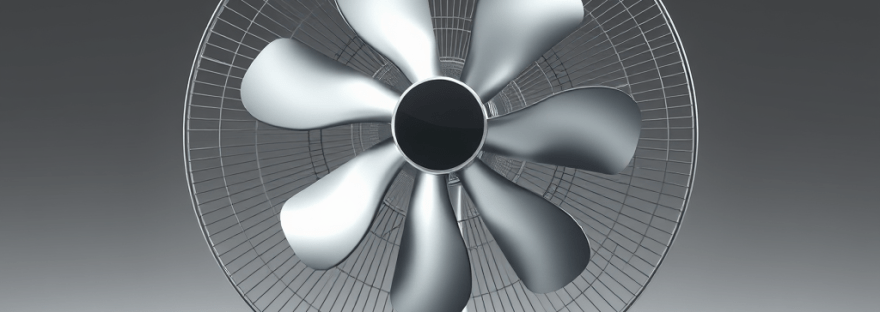
We imagined an electric fan. We could manually spin the blades and create a slight breeze. Obviously, we would have to consistently place our fingertips on the top of the slowing blades to give it another spin. Our entire attention would be devoted to managing the spin of the blades. Our obsession with keeping those blades spinning would consume us, and we would be able to accomplish little else.
If, however, we became willing to plug the fan in to an electrical socket, the blades would spin without effort, in a smooth rhythm, independent of our attention. The effects would be much more noticeable, yet effortless. We could remain active and alert with the more important duties of life, comforted by the breeze of an unseen power.
Faith and doubt, while appearing to be polar opposites, are the alternating currents which work together, generating an absolute belief in Christ. We cannot fully resolve our doubts within our faith. That’s why Jesus tells us time and time again, “Only believe.”
Faith in wholeness, when we felt so broken, was more work than we anticipated.
We worked to believe that somewhere in time, we would possess this shalom which Jesus had bequeathed us before His death.
We worked to believe, when doubts bubbled to the surface after losing our temper, feeling depressed, or experiencing muscle cramps from the lingering effects of the toxins we had used.
We worked to believe our shattered lives could be put back together when legal issues remained unresolved and court cases loomed in our future.
We worked to believe that Jesus’ wholeness could restore us to our original value when we found ourselves faced with the wreckage of our past and the rejection from our families.
We worked to believe in the wholeness of Christ coursing through our veins, restoring the health of mind and body when our inner voice kept telling us we were being foolish and naive.
Finally, we concluded that the only way to test this hypothesis was to presume the words of Jesus were true and choose to believe that they might actually be able to work for us. It seemed worth a shot. After all, we were out of options, so what did we have to lose?
People were coming to Jesus from every town and city.
***************************
Finding Jesus in ordinary places is not difficult for you. While it is true He is not on this planet in His earthly form, you are able to detect His presence when you distance yourself from places and things which tend to distract you.
In your birthday verse from the book of Luke, it states that the people left their towns on a quest to see Jesus.
In a similar pattern, you too have your most intimate encounters with Christ when you are away from the city lights and the chaos of human interaction. You experience the presence of Jesus when you are in a solitary space.
Sometimes this is a literal endeavor, when you get off by yourself into a open air setting to connect with creation. You see Jesus more clearly when you shift your focus away from natural events in order to catch a glimpse of the supernatural.
This is not a rational process, nor does logic come into play. To see Jesus, there must be faith that He will be there when you arrive.
As you practice removing yourself from what is familiar and stepping out in faith, you are able to recognize Jesus more clearly. Refreshed by His energy, you find harmony and healing.
When you leave all the distractions behind, you are open to the sense of His presence in everything you see.
Your desire to see Jesus, and the effect He is having on the world around you, is the driving force for your divine destiny.
You do not remain set in your ways, with a rigid schedule of daily duties. You sketch out a tentative plan in your mind each morning, but remain open to changes as the Holy Spirit directs your day.
The terms chance and coincidence are not part of your vocabulary. You set out each day to find new evidence of divine intervention in ordinary events and you are never disappointed by what you discover.
Jesus appears to you in many forms. He weaves Himself in and out of your day, energizing you with a sense of love, power, and confidence.
Sometimes you see Him in other human beings. Sometimes you see Him in animals and plants. You see Him in science and are passionate about discovering the complexities of the Creator’s design on this planet.
You hear Him in thunder and the whistling winds. You hear Him in music and laughter.
You hear the rustle of angel wings in the melodies of old hymns. You overflow with emotion when the gentle breeze of His Spirit whispers your name in the stillness of the night.
You discover the presence of Jesus when you seek Him. You remain alert and aware of His influence and promptings on a minute by minute basis.
You are willing to walk away from what distracts you in order to get a clear view of His presence.
Your prayers are not traditional or eloquent. They are more like a casual running conversation with a close friend. His gentle peace surrounds you as His presence lights up the path where you walk.
We concluded that the Creator of the Universe would not waste time weaving intricate limbic, nervous, and immune systems into a human body, without giving it a reason to exist. It seemed to us that any created life, if not accompanied by a series of assignments designed to enhance the world, would simply be a waste of time.
Imagining that God would create a life without purpose and then place it into a magnificent universe, seemed like hanging macaroni pictures in an art gallery. We felt that God would not busy Himself with kindergarten crafts to decorate the door of His fridge. He would not create a living being which possessed no real purpose or direction, or worse, one with evil intent or the inability to produce a positive impact on the planet.
We acknowledged that the King of the Universe had a specific design for every human being when He placed their spirit into a body. We believed that by the time the organs were developed, and the heartbeat could be heard, each tiny body possessed a spirit with divine directives of cosmic proportions. We were saddened by the realization that if any spirit failed to be awakened to the Creator’s heart, it would be vulnerable to an enemy who would capture and use it for his own purpose.
In the hands of the Evil One, this fragile spirit would be destroyed, and a divine destiny would remain unfulfilled, leaving a gaping hole in human history.
We agreed that our divine assignments could no longer be viewed as optional. We were given life, and therefore, a destiny. The fact that we took another breath meant our destiny had not yet been fulfilled.
Tetelestai Recovery 2: Our New Normal; Chapter 8, The Open Road
In our New Normal, it seemed that forgiveness was an issue we struggled with at every turn. Failure to forgive made us feel guilty. Trying to forgive made us feel irritated. Convincing ourselves that we had already forgiven, when we knew we hadn’t, made us feel like phonies. It all just seemed too much. When someone did us wrong, and we incurred a loss of self-worth, inner peace, reputation, or security, did God really expect us to forgive the offense and get over it?
Was it His intent that we sustain our losses and silently endure offenses to our own demise? We didn’t think that sounded like the reasonable expectation of a loving, protective Father! We thought there must be more to this concept of forgiveness than just suffering in silence and becoming a speed bump to anyone who ran over the top of us.
Vengeance is Mine; I will repay. Deuteronomy 32:35
We examined this Sacred Text carefully and realized it contained two separate promises.
The first phrase was a promise that God would be bringing justice to the offender. The second phrase confirmed that God would repay us for the damage we sustained.
When we were offended, disrespected, lied to, or abandoned, we suffered humiliation, rejection, and loss of self-esteem. Therefore, since God promised to repay us for our loss, and exact revenge on the one who wronged us, then the forgiveness issue was less about protecting ourselves and more about trusting in a God of justice who promised to set all things right.
Tetelestai Recovery 2: Our New Normal; Chapter 7, Keeping it Vertical
Our faith grew stronger each day. We encouraged one another with words of faith. We received ‘coincidental’ messages which confirmed and clarified other insights we had received from a different source. We soon realized there was nothing even remotely coincidental about these messages. In fact, we were elated to discover there was nothing left to chance at all. God was choreographing each of our steps, creating a joyful dance out of our awkward stumbles.
There were times when we received an identical message topic or scripture from several different settings in a single day. There were also times when our dreams gave us the answer to a problem we couldn’t solve. And other times, we were hit with a divine download so profound; it was as if a thousand thoughts were dumped into our brains at once. They swirled in a circle like a change counter at the bank, each idea fitting perfectly into the slots, so that the concepts which once perplexed us suddenly became organized and crystal clear.
Tetelestai Recovery 2: Our New Normal; Chapter 5, The Fear Factor https://a.co/d/dYQkMGX
Through their personal journey of recovery, the authors present indisputable evidence that total healing and release from the disease of addiction can be found through the final declaration of Christ, “It is finished!”
Whether you are a suffering addict; an exhausted 12-stepper; a chronic relapser; or a person who loves one, Tetelestai Recovery will open your eyes to the possibility of permanent sobriety without the struggle.
This revolutionary concept is bringing radical changes to the recovery community. Within the pages of this book you will learn how to move out of your addiction and into your destiny.
You are here for a reason and it’s time to find out why.

















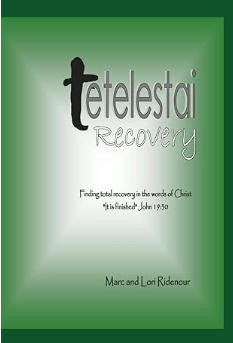
 Finding Total Recovery in the Words of Christ, "It is Finished!"