

Tetelestai Recovery

Guilt and Remorse

When our dark thoughts are triggered, feelings of regret and shame make us cringe. We respond by gathering up our baggage and taking a trip down memory lane. We wrestle with our past and try to rewrite the narrative. We justify, rationalize, and analyze. We surrender to the downward spiral and wonder why we ever believed we could outrun our demons.

After sliding into the abyss of our never-ending regrets, our insides feel hollow, and we become hopelessly despondent. The weight of remorse becomes too heavy to carry. We wonder how we can ever rise above this base line of our worst selves.

These thoughts can snowball and take us under for days. The avalanche of our wrongness buries us in a cold dark tomb of guilt. We are irritable, depressed, angry, and nauseous. We lack motivation and have no sense of purpose. It seems God is so far away, and it is pointless to pray.

To level up, we must develop healthy thought patterns and discipline our minds to stay on a positive track. We can no longer allow our thoughts to wander aimlessly through the minefield of our worst imaginations. We must carve new pathways for our thoughts to travel. We need to keep our thoughts on the high road and pump the brakes when we are headed for the ditch. But how?

…Chapter 9: Hold That Thought

Tetelestai Recovery

Full Coverage

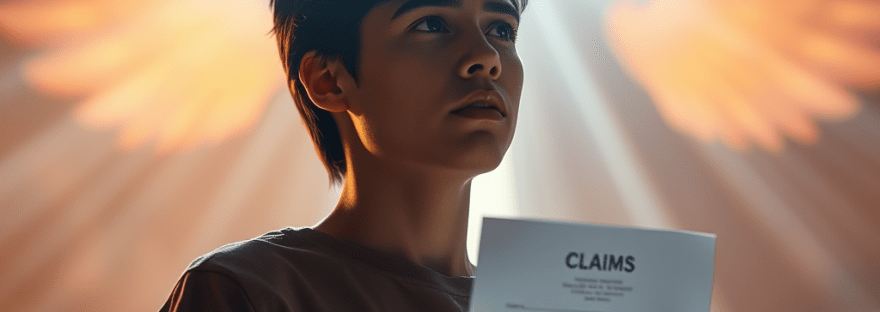
Forgiveness doesn’t mean we are required to sustain the damage done to us. Nor does it mean we must act like it never happened and open ourselves up to additional injury. Forgiveness means we invoke the rights of our Divine Insurance Policy and submit our claims to the God of Angel Armies.

Full coverage guarantees a 4-R response. God promises to: Reimburse us for our loss; Repair our damage; and Restore our dignity. The 4th R is Revenge for our assailants, which God promises to dole out in justice, provided we not try to attempt it ourselves.

We want proof that God will extract payment from those who damage us. We find our answer in both the Old and New Testaments:

I will return on your own heads what you have done.” The Lord has spoken. Joel 3:7

They will be paid back for the harm they have done. 1 Peter 2:13

We learn that we need not exhaust ourselves with horizontal efforts to recover our losses by extracting payments from those who owe us more than they could ever repay, even if they wanted to. We simply submit our claims to God and wait for His reimbursement. We can finally relax and forgive as we let go and let God. It’s a vertical issue!

Tetelestai Recovery 2: Our New Normal; Chapter 7, Keeping it Vertical https://a.co/d/hZqCsPe

Tetelestai Recovery

The Things We Cannot Change

The Serenity Prayer speaks of accepting the things we cannot change. Obviously, there are circumstances and people in our lives that we have no power to change, but we do have the option of adjusting our perspectives to make the best of a bad situation.

But what about the past? We cannot change the past. We can either forgive it or be doomed to relive it, but we can’t change it.

Oh sure, we may try to rewrite history and adopt a more sanitized version of the role we played in each event. This habit is not about dishonesty or refusal to take responsibility, but rather, it is about our inability to bear up under the shame of who we once were. We cringe when a memory is triggered, or a past behavior is thrown in our face. Some of us have felony convictions, divorces, failed careers, and a group of resentful people waiting in the wings, ready to dig up our sordid past, preferably in public view.

We tiptoe carefully through the thorny thicket of public events and social media posts, hoping to avoid any references that might puncture our day. Sadly, from time to time, we encounter someone who learns about our past and gathers the ugly details to use as an arsenal of accusations meant to destroy our reputation and damage our credibility.

We are certain that God has given us a new life in Christ. Yet, we also worry that our past will not stay silent forever. We fear that it is only a matter of time before it resurfaces, shattering our new lives to bits.

This may sound overly dramatic to someone with a stellar past, but for those of us who have done deeply regrettable things, there is nothing that can knock us down quicker than a shameful past invading our new lives. With fury and force, these thorns and thistles are aggressive propagators, leaving us hopelessly tangled in a thicket of our failures.

Accepting the past is a difficult thing to do. It is even more difficult when we are asked to explain it. Emotions are triggered. Shame is ignited. The fear of rejection and abandonment rises to choke us. And the most excruciating part is, every time our past comes back to haunt us, we are forced to relive it, watching ourselves play the role of someone we hate.

…Continue Reading https://a.co/d/aarn6Nh

Tetelestai Recovery

It’s a Choice

Considering whether or not God can actually forget our sins, leaves us with two important theological questions:

  • If God can forget things, then how can He be all knowing?
  • If God can’t forget things, then how can He say that He remembers our sins no more?

Forgiveness is extremely difficult for us, so we assume that it must be even worse for God because he is all present, all powerful, and all-knowing.

In our human relationships, we like to believe that the people we have wronged will gradually forget about it over time. But with God, we know that’s not an option because He exists outside of time. There is no movement of time in the spirit realm. He is everything, everywhere, all at once.

So, we have to ask ourselves, “How can God say that He forgives us and remembers our sins no more?” The answer is simple: He chooses not to remember.

Because He is God, he can make choices that are outside the bounds of human ability. With the attribute of omnipotence (all powerful), He can make the choice not to remember.

In Isaiah 43:25, God says, “I will not remember your sins.”

In Jeremiah 31: 34, “I will forgive their iniquity, and their sin I will remember no more.”

Hebrews 8: 12 and Hebrews 10:17, “Their sins and their lawless deeds I will remember no more.”

There is nothing to indicate God absentmindedly forgets, as if He suffers from dementia or it just slips His mind. Rather, in His infinite mercy, He chooses not to remember the wrongs that He has forgiven. Therefore, we conclude that surface level theology says, “God forgets,” while leveled-up theology says, “He chooses not to remember.”

Continue Reading https://a.co/d/et0BASS

Tetelestai Recovery

Settling the Score

In our New Normal, it seemed that forgiveness was an issue we struggled with at every turn. Failure to forgive made us feel guilty. Trying to forgive made us feel irritated. Convincing ourselves that we had already forgiven, when we knew we hadn’t, made us feel like phonies. It all just seemed too much. When someone did us wrong, and we incurred a loss of self-worth, inner peace, reputation, or security, did God really expect us to forgive the offense and get over it?

Was it His intent that we sustain our losses and silently endure offenses to our own demise? We didn’t think that sounded like the reasonable expectation of a loving, protective Father! We thought there must be more to this concept of forgiveness than just suffering in silence and becoming a speed bump to anyone who ran over the top of us.

Vengeance is Mine; I will repay. Deuteronomy 32:35

We examined this Sacred Text carefully and realized it contained two separate promises.

The first phrase was a promise that God would be bringing justice to the offender. The second phrase confirmed that God would repay us for the damage we sustained.

When we were offended, disrespected, lied to, or abandoned, we suffered humiliation, rejection, and loss of self-esteem. Therefore, since God promised to repay us for our loss, and exact revenge on the one who wronged us, then the forgiveness issue was less about protecting ourselves and more about trusting in a God of justice who promised to set all things right.

Tetelestai Recovery 2: Our New Normal; Chapter 7, Keeping it Vertical

https://a.co/d/8KdgTwa

Tetelestai Recovery

Keeping it Vertical

We are damaged humans who have been damaged by other humans. Our only hope of recovery is to submit our claims to God and wait for Him to reimburse us for our loss.

We finally understood that when Jesus instructed us to forgive, He was not telling us we had to sustain damage and accept it as okay. He was also not telling us that we didn’t have a valid claim. In fact, He was stating the exact opposite.

The fact that forgiveness was necessary, meant a loss was incurred and damage sustained. He was not denying our claim. He was validating our loss and confirming its legitimacy.

He never suggested we just get over it. He wasn’t instructing us to learn to live with it and then congratulate ourselves on taking the high road.  He instructed us to forgive because he wanted us to access His full coverage comprehensive plan. In other words, Jesus was telling us, “Submit your claim to me, and I will handle all repairs and collections.” He knew that the process was too exhausting and complicated for us to deal with on our own. He also knew that when two humans try to settle, they rarely get it right and they seldom get it done.

Tetelestai Recovery – Our New Normal

Chapter 7 – Keeping it Vertical

https://a.co/d/buLJkOl