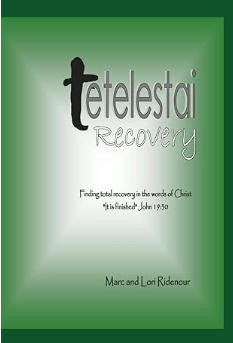
Tetelestai Recovery

Upside Down Perspective

The upside-down declarations of a fallen world rang out loud and clear:

  • Trauma causes permanent damage.
  • Don’t get your hopes up or you will be disappointed.
  • Nothing gets better; everything is getting worse.
  • Life will kick you down.
  • You are growing more weak, frail, and overwhelmed.
  • The world’s message was abrupt and hopeless: The end result of life is death.   

The inauguration of triumph within Christ’s victory cheer, “Tetelestai!” turned these statements right side up. Much like the development of a photograph from negative filmstrip, black became white, white became black, and color emerged, as the world was submerged in the bright red solution of Jesus’ blood.

The law was fulfilled, the curtain was torn, and the New Covenant eliminated the curse, opening the floodgates of blessing for all. The responsibility of the covenant rested solely on the finished work of Jesus. No more sacrifice could outperform the one which announced, “It is finished!” His declaration broke the curse and banished the old covenant of law. Blessings became contingent on Christ’s obedience rather than our own. We found within that realm of grace, the script was flipped, and hope was born.

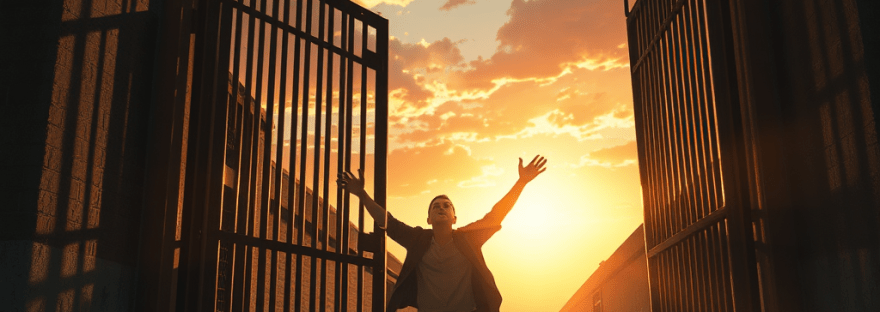
For forty years, from the time Peter watched his Savior and friend leave this world, airlifted by a fanfare of angels, he had been on a journey of enlightenment. He had become painfully aware of just how upside-down this natural world really was. He had learned, through the power of the Holy Spirit, to walk in a supernatural existence, free from natural limitations. He personally encountered events in which prison led to freedom, death led to life, and sickness led to health. An angel had walked him out of a maximum-security prison. People were raised from the dead on his watch. Some were healed when his shadow passed over them. When Jesus told Peter he would be doing greater miracles that the ones he had seen his Teacher do, He wasn’t exaggerating!

Peter recognized this world for what it was: an upside-down creation waiting to be turned right-side-up. Peter walked upright for many years, against the grain, in an upside-down world where most people just didn’t get it.

We wondered if Peter realized the significance of his choice to die upside-down. From that perspective, looking out on his crowd of accusers, who appeared to be hanging by their feet to a dusty sky, he was given a glimpse of how distorted one’s viewpoint could be, when looking at things upside-down.

https://a.co/d/1GCS1Ca

Tetelestai Recovery – Chapter 4 – Our New Perspective

Tetelestai Recovery

Water Walkers

When Jesus was spotted by His friends, coming toward the boat, they first thought He was a ghost. He knew what they were thinking. Although they should have been relieved to see Him, they were, in fact, terrified instead. He saw the horror in their eyes and realized they weren’t recognizing Him for who He was.

We recall times when we were unaware that Jesus was approaching, and we became frightened by our own misperceptions. We saw death approaching, but in the end, it proved to be the Author of Life. The disciples thought they were seeing a ghost. And much like those young men, we too become afraid of what He represents. Some fear He will leave them. Others fear He will prohibit their self-expression. Some fear He will demand too much or create too much controversy. Many of us encountered a fear of Jesus, not fully understanding who He was or why He’d come.

 Jesus comes to us in different forms. Sometimes He comes in the supernatural realm as an unmistakable tingle of the Great Spirit. Other times He approaches through the Presence of other addicts and inmates whom we fondly refer to as our cell-siblings. Addiction, incarceration, disease, and anxiety were some of the worst storms in our lives, and we were sure some of these issues would be the death of us. Yet, in the midst of these storms, Jesus appeared and offered the opportunity to take a leap of faith and join Him in the supernatural.

In the Sacred Text account, one of the men in the boat, named Peter, asked Jesus to let him come out and walk on the water alongside Him. Jesus of course said, “Sure! Come on out. The water’s fine.” Peter lunged toward the side of the boat as it was rocking and lurching, climbed cautiously over the edge, and slowly lowered his weight onto the swirling liquid. If Jesus was a fraud, the next few seconds would have been the moment of truth. In former miracles, the people who were healed and delivered could have been in cahoots with Him on some elaborate hoax. However, walking on top of water, and inviting another human being to join Him would have been impossible to pull off, had it been a ruse.

The interesting part of this story is when it is taught as an object lesson in some churches, the point always seems to hover over the fact that for a split-second Peter took his eyes off Jesus and began to sink below the surface of the waves. Many preachers belabor the point that Peter lacked faith. We disagree!

There were 11 other men in the boat who didn’t even ask if they could come out onto the water. Peter had faith! Whether he was completely successful in his faith walk or not, he was the only one with the intuition to ask if he could get out of the boat. He was the one who believed in Jesus’ ability to empower him to do it. He knew that in the midst of the storm, the safest place to be was with Jesus. In that moment of clarity, Peter suddenly received a divine revelation. Through this text, we receive the same revelation in our storms. We need not remain powerless and desperate. We are called to function alongside our King, even when natural laws dictate otherwise. Believers can overpower the Natural with the Supernatural.

The power in the spirit realm is faith, and Peter’s faith was increasing exponentially with every risk. His faith account was small, but it was growing. When Jesus asked him “Oh you have such little faith, why did you doubt me?” He was simply letting Peter know that as his faith increased, so would his ability to maintain his position of power in the Spirit realm. Pointing out that Peter had ‘little’ faith was not a reprimand but rather, an encouragement that when his faith grew bigger, it would become more reliable, enabling him to fulfill his call.

Chapter 12 – Water Walkers

https://a.co/d/4EPgCli

Tetelestai Recovery

Use Your Words

This is a word created universe, and we have been given the authority of Christ to create our world with His words. What we believe, we speak, and the manifestation takes place.

Sometimes it is instantaneous, like a light switch. Other times it is a gradual process, like a dimmer switch.

We saw in the passage in Mark 11 that the tree took some time to die. Therefore, we were faced with the challenge to first believe, then speak, and then wait. We noticed that Jesus didn’t stand there waiting for the tree to die. He went on about His business and allowed His words to do the work.

In the same mindset, we learned it was best not to examine our progress, but only to believe and continue on our path. Days, months, and even years later, when encountering humiliating experiences, or running into old acquaintances, we were surprised to see that our emotional responses were no longer rooted in shame, but rather in strength. We found those mountains which loomed in our future had disappeared and our paths were leveled.   

 As we learned about words creating the world we desire, we understood that our words could destroy our root of shame. Once the root was dead, no one else, including ourselves, would be subjected to the fruit that grew from it.

Those mountains which needed to move would not be moved by exertion or self-effort. We could not uproot our shame any more than we could move a mountain. Both were subject to the same force, the spoken word. Knowing that the only energy that travels from the natural realm to the spiritual realm are our words, we speak to our shame and command it to bear no fruit. We speak to our mountains, and they disappear into the sea.

We declared the words of Jesus, “It is finished!” to our roots of shame and our mountain of amends.

As our mountains dropped into the sea, a tsunami of opportunities flooded into our lives. Wave upon wave of amazing possibilities washed over us.

Chapter 11 – Roots and Mountains

https://a.co/d/goEXNS8

Tetelestai Recovery

Hold That Thought

Finally, brothers and sisters, whatever is true, whatever is noble, whatever is right, whatever is pure, whatever is lovely, whatever is admirable—if anything is excellent or praiseworthy—think about such things. Philippians 4:8

We had been healed and delivered by the final words of Jesus from the cross, “It is finished,” so we knew there was significance in last words.  We understood that enormous effort goes into choosing the right words to say goodbye, finish a letter, conclude a speech, or summarize a presentation. Final words are important. They leave a lasting impact and have far reaching effects.

What began with the word finally, impacted us so deeply, we were never the same.

Our cognitive distortions and faulty thought patterns were measured against the 8 descriptive words in Philippians 4:8.  With these eight guardrails in place, we could choose which thoughts to keep and which ones to set aside.  Using the acronym, PREPLANT, we could check ourselves regularly throughout the day to make sure the thoughts running through our heads lined up with at least one on the list.

PURE – RIGHT – EXCELLENT PRAISEWORTHY – LOVELY – ADMIRABLE NOBLE – TRUE

If a thought did not meet the criteria, it was deemed unhealthy and carried the potential to make us sick.  We could not level up until we let go of the thoughts that didn’t measure up.

Tetelestai Recovery

Yes and No

As we leveled up in our new normal, we had to adopt the same type of mindset with our life choices as we did for driving on muddy country roads.  Our decisions and actions needed to be precisely calibrated in order to achieve the results we wanted.  Just as it would be foolish to see how close to the ditch we could drive without sliding off the road, it was also foolish to see how close we could get to temptation without giving in.  

In our leveled-up position, we learned that every action started with a choice. And every choice carried an equal and opposite result. In other words, every choice carried both a yes and a no decision.

If we said yes to sobriety, we said no to the chaos and destruction we once lived. And visa-versa.  If we said yes to a drink or drug, we said no to hope and sanity. When we said yes to thinking out our choices, we said no to making the same dumb decisions over and over, expecting different results.

To level-up, we had to accept our own responsibility for the choices and events of our lives. We had to realize that our decisions, even in little things, mattered.   Whether it was getting a good deal on a laptop we suspected was stolen, or working the system to get benefits we didn’t really qualify for, every decision set off a chain reaction of negative results and consequences.

We evaluated some of our individual experiences and shared them with the group.

One member who had been an addiction to porn, shared his decision-making process when it came to watching television.  He knew which shows would trigger lustful thoughts, so he simply chose not to watch them.  He chose instead to watch sports, cooking shows, and educational programs like Nova. He said yes to living free from his addiction which meant he said no to shows that triggered him.  Each time he made that choice, he placed himself into a position of freedom. He continues to pursue his destiny using the wisdom God has given.  He has leveled up into a mature, godly man who demonstrates great leadership skills. 

Another member of the group shared about self-esteem issues. From childhood, he had been trying to cope with the confusion of trauma, unaware of what to call it. He struggled with feelings of unworthiness and was unable to feel a sense of value.  That all changed when he made the choice to learn about trauma and its effects. He chose to develop a relationship with Jesus, his Healer.  He made a choice to forgive and move away from the pain. Because he said yes to openness, and no to suffering in silence, he now operates in a position of power and serves as an advocate for others. He has the wisdom of God and the heart of a servant.

Another member shared about his past life of uncontrollable rage.  He spoke about feeling as if he had no choice when it overtook him. His experience with rage was like driving on a slippery, muddy road at full speed, headed straight for the ditch, and unable to stop.  It was hard for us to believe he had ever struggled with rage. This was a man who carried the joy of the Lord on his face. His smile was contagious, his demeanor was gracious, and he radiated positive energy whenever he walked into the room.  He often spoke of love and forgiveness as if it were his lifeline.  He had made a conscious choice to forgive whenever he was wronged. He refused to carry a grudge, but instead, chose to walk in love. He said no to rage and yes to compassion. Forgiveness and joy were no longer second nature to him; they were his new normal. 

Tetelestai Recovery

Crisis Management

If our car was falling apart, we took it to a mechanic.  If our house was falling apart, we called a handyman. If our grades were falling apart, we hired a tutor. But where could we go when our lives were falling apart? What should we do when things were unraveling at a rapid pace and we didn’t know what to do?

If we failed to cultivate fertile soil for the seeds of faith to grow in our minds, hearts, and spirits prior to an upcoming crisis, we found ourselves in a panic. We experienced fear and uncertainty. We felt like our lives were out of control.

However, if we shifted our focus away from the crisis at hand, we found that our connection with God transformed from textbook theology into a powerful manifestation of His presence. 

Getting through a crisis successfully is a process.  It begins with a foundation of the knowledge of God, the belief in Jesus Christ, and the power of the Holy Spirit guiding us toward solutions rather than panic, anxiety, and fear.

When leveling up, we learn the value of a disciplined mind during crisis. We practice making conscious decisions to redirect our thoughts away from anxiety. We train ourselves to run to God for a solution. It takes effort and practice to make this our go-to move.  It doesn’t come naturally at first, so we sometimes spend a lot of time cycling through stages of anxiety, obsession, fear and what-ifs, evaluating all possible outcomes before we finally remember where to find our relief. 

We come to believe that the common phrase, ‘Hope for the best and plan for the worst,’ is a faithless, pitiful position, to take.

Therefore, in our leveled up status, we practice a new expression:

Hope for the best and plan for divine intervention.’

Tetelestai Recovery

The Revolution

As we opened our minds to sacred text, the revolution began.  

We discovered new parameters for our belief system.

I Corinthians 2:16 stated, “We understand these things, for we have the mind of Christ,so we released our mental constraints and became aware of our new understanding.

2 Corinthians 5:17 told us that “Anyone who belongs to Christ has become a new person. The old life is gone; a new life has begun!” Therefore, we resisted the temptation to dwell on the past. We had become a new creation in Christ, so there was no past to lament.

We believed that our feelings were fickle and could not be the focal point of our attention. We did not regard our feelings as a reliable source of information. The Word of God became our compass, and we only said of ourselves what we would say of Christ. We professed that we were in Christ and have inherited the privilege to participate in a life of His perfection. We were the righteousness of God, even when we felt like we had failed. The cross inverted all our wrongs and made them right. Thus, the rightness of Jesus outweighed the wrongness of our misdeeds.

________________________

  • We began to thank God for His provision, even when we felt needy.  

The Lord is the Spirit, and where the Spirit of the Lord is, there is freedom. 2 Corinthians 3:17

  • We believed God for His righteousness, even when we felt wrong.
  • We believed in ourselves as new creations, even when we felt damaged.
  • We stopped living in regret, even when we felt as if we should.

We no longer identified with who we were, but rather, we identified ourselves as who we became at the moment, we received our tetelestai revelation. We had come to know love which we had never known before. We had received a personal pardon from the King of Kings and according to Ephesians 3:19, we were becoming filled with the fullness of God, which was gradually squeezing out our tendency to be full of ourselves.

Tetelestai Recovery – Finding Total Recovery in the Words of Christ, “It is Finished!”

Chapter 3 – The Revolution

https://a.co/d/d07jCDe

Tetelestai Recovery

A Contaminated Mind

Although our spirits were reborn and our bodies were clean from mood altering substances, our minds were contaminated with cognitive distortions. Our thought processes had become corroded with bitterness and disappointment. The original shine of innocence had been dulled by the storms of rage and the heat of humiliation. Our minds were splattered with the dirt and grime of the past. The good memories were cluttered with grief over what we ruined or what we lost. The bad memories made us cringe and flooded us with waves of nausea. Our heads were filled with regrets, resentments, and realities that we wished we could change.

Our minds, once fresh and innocent, had gradually become a gurgling caldron of foul emotions, which continued to bubble up at the worst possible times. Most of us couldn’t even remember what a fresh, clean mind was, nor could we identify exactly when we lost ours. Clever coping mechanisms had served their purposes for a time, but we were tired of being covered in the dirt and grime of resentment, guilt, failure, fear, intimidation, and regret.

Our minds needed to be scrubbed clean if we were ever going to have the confidence and clarity to move into our destiny. So, we looked for answers in our Sacred Text…

Tetelestai Recovery Volume 2 – Our New Normal

Chapter Three – Brainwashed

https://a.co/d/5BARYRi

Tetelestai Recovery

Feelings Versus Truth

We know that our emotions can be a powerful force that affects us, body, mind, and soul. We also know that Jesus has made a way to escape being controlled by our feelings, which can range from pesky to obsessive or even frightening.

We are told in the Word that we have been made the righteousness of God in Christ. This flies in the face of feelings which indicate something is wrong with us. Our feelings are no match for the Word of God. If the Creator of the universe says we are righteous, then our emotions have no right to dispute it.

We have been made right by the blood of Christ which was donated as a divine transfusion to heal us from the inside out. The emotions we feel, the sounds we hear, the words we say, and the images we see, must all defer to the words of our King who has decreed tetelestai over all that is wrong with us.

Tetelestai Recovery – Finding Total Recovery in the Words of Christ, “It is Finished!”

Chapter 2 – Feelings Are Not Our Truth

https://a.co/d/9xYXEvV

Tetelestai Recovery

Keeping it Vertical

We are damaged humans who have been damaged by other humans. Our only hope of recovery is to submit our claims to God and wait for Him to reimburse us for our loss.

We finally understood that when Jesus instructed us to forgive, He was not telling us we had to sustain damage and accept it as okay. He was also not telling us that we didn’t have a valid claim. In fact, He was stating the exact opposite.

The fact that forgiveness was necessary, meant a loss was incurred and damage sustained. He was not denying our claim. He was validating our loss and confirming its legitimacy.

He never suggested we just get over it. He wasn’t instructing us to learn to live with it and then congratulate ourselves on taking the high road.  He instructed us to forgive because he wanted us to access His full coverage comprehensive plan. In other words, Jesus was telling us, “Submit your claim to me, and I will handle all repairs and collections.” He knew that the process was too exhausting and complicated for us to deal with on our own. He also knew that when two humans try to settle, they rarely get it right and they seldom get it done.

Tetelestai Recovery – Our New Normal

Chapter 7 – Keeping it Vertical

https://a.co/d/buLJkOl