Through their personal journey of recovery, the authors present indisputable evidence that total healing and release from the disease of addiction can be found through the final declaration of Christ, “It is finished!”
Whether you are a suffering addict; an exhausted 12-stepper; a chronic relapser; or a person who loves one, Tetelestai Recovery will open your eyes to the possibility of permanent sobriety without the struggle.
This revolutionary concept is bringing radical changes to the recovery community. Within the pages of this book you will learn how to move out of your addiction and into your destiny.
You are here for a reason and it’s time to find out why.
We noticed something remarkable about the ministry of Jesus. He had no schedule or agenda. His ministry was not directed by Himself, His apostles, or even by God. To our amazement, we realized that the ministry of Christ was determined by people. Without fail, when the slightest flicker of faith sparked, or a request for mercy was whispered, the Savior’s footsteps suddenly stopped.
Tetelestai Recovery / Chapter 8, Facts are Changeable
Initially, we feared awakening resentments and regret, but with God at our side, we grew confident that there was nothing we couldn’t face and forgive. As much as we felt our history was set in stone and fossilized forever, we claimed the following Sacred Text over our emotional excavation:
Behold, I am the Lord, the God of all flesh. Is anything too hard for me? Jeremiah 32:27
In time, we became willing to enter our valley of dry bones and speak life over what had been dead for so long.
We found the lifeless remains of enthusiasm, which had been suffocated by disappointment. We found fossils of unfinished projects, which might have been profound, had we not given up. We unearthed splintered fragments of gifts, talents, and abilities which had become casualties of our own sense of inadequacy.
Rather than viewing the carnage as evidence of a wasted life, we began to see it as dry bones coming back to life. By faith, we saw a powerful future rising up from the wreckage of our past.
In our New Normal, we spoke life over anything which reeked of death. In our New Normal, we commanded our dead dreams to rise up in service to our King. We did not think this was too much to expect, for we had been given the resurrection power of Christ. We had been urged to follow in the footsteps of our Creator, who…
Gives life to the dead and calls into existence things that don’t yet exist. Romans 4:17
They arrived in Bethsaida. Some people brought a sightless man and begged Jesus to give him a healing touch. Taking him by the hand, he led him out of the village. He put spit in the man’s eyes, laid hands on him, and asked, “Do you see anything?”
He looked up. “I see men. They look like walking trees.” So, Jesus laid hands on his eyes again. The man looked hard and realized that he had recovered perfect sight; saw everything in bright, twenty-twenty focus.
Jesus sent him straight home, telling him, “Don’t enter the village.”
Mark 8:22-26
*************
Like the blind man in this passage, we needed a second touch from Jesus to heal our distorted view. All we had to do was be honest and admit that our perspective was still distorted. Jesus didn’t scold the man for not having enough faith, or for being inadequate. Jesus simply asked him what was wrong and then fixed it.
At the end of the story, after the man’s vision was perfectly restored, Jesus told him to go straight home and not to go back into the village. In our own parallel stories, we heard Jesus say, “Don’t go back into….”
We each heard a different ending to that sentence, based on our own uniquely personal experience. For all of us, it was a moment of truth. If we wanted to enjoy our total Tetelestai Recovery and be comfortable in our New Normal, we would not be able to return to that person, place, or thing which was certain to pull us back into our distortions.
In the original Greek language, the word for the phrase “It is finished”is Tetelestai.
I was introduced to the word Tetelestai one day when I was well into my fourth year of permanent healing from addiction.
It was during a year-long court battle which had been a residual consequence from my old life. The day I appeared in court to hear the verdict and receive my sentence, I claimed this scripture and the word Tetelestai over my case. I was relieved by the peace it held and became willing to accept whatever God had in store for me, even if it meant a year in prison.
I prayed this scripture and acknowledged the fact that God had already redeemed me. He had made me a new creation by healing me from addiction. As I was praying that morning, God was working on the judge. He gave the judge an insight into something that no one else had seen…
The work of Christ was miraculous and supernatural. His wholeness could not be explained or understood. What was broken became whole and what was missing began to appear. The void was no longer an empty vacuum demanding to be filled. We had living water to relieve the spiritual thirst which once drove us to the bottle. We derived pleasure and relief from the intoxication of the Holy Spirit which far exceeded the effects and duration of our former chemical concoctions.
As we received this shalom of our Savior and trusted that He refused to leave us broken or misplaced, we understood that this was what scripture defines as the gift of salvation.
We are not the broken people we once were. We need not fear that anyone will discover our inadequacies, for we have everything that we need. The proof is not always there, but the truth is. We bring our faith and our doubts to Him, and in return, He offers us shalom.
We enter a new realm of confidence in Christ. To our brokenness and emptiness, a strong clear voice declares from the cross and echoes into our void, “Tetelestai!”
I was born into a two-parent alcoholic home and struggled for decades with drug and alcohol dependence. I started drinking as a small child and was a daily drug user by age twelve. I was blessed with a willfully strong intellect and despite my addiction issues, went to college, started a family, and became a successful entrepreneur. By age twenty-six, my occasional, yet increasingly frequent business, relationship, and legal problems caused me to seek relief from my struggle with drugs and alcohol.
I had an intellectual concept of a spiritual energy (Higher Power) and over the next twenty-seven years, I cycled in and out of sobriety, with the assistance of 12-step recovery meetings and multiple treatment institutions. In that twenty-seven-year period I worked steps, had sponsors and sponsees, attended meetings, worked service jobs and attended counseling. Despite what some would say was a strong recovery program, I continued to relapse with multiple auto wrecks, work accidents, play injuries, DUI’s, loss of relationships, divorce, and spiritual discourse. Consequences continued to mount and got more severe. I agonized over what I was doing wrong and often asked myself, “Why can’t I seem to get it? Why can’t I stay clean and sober?”
Bouncing from program to program I became active in four different 12-step programs and had a daily ritual of meetings to attend. I continued to relapse again and again over resentments, old acquaintances, the “disease”, and the never-ending discussions and excitement about the glory of the ‘good ole days’. My angst would grow until I would try a different drug or go back to my good old friend alcohol.
Faith in God or my version of a Higher Power, became shaken, questioned, and eventually dismissed.
As far back as we could remember, we felt different, damaged, and just plain wrong. We did not know exactly what was wrong with us. We only knew that we felt things more intensely than others and we processed our problems with great difficulty.
We obsessively examined ourselves, looking for clues to solve the mystery and to find a key which would unlock some invisible door into normalcy. We noticed people we admired and made feeble attempts to imitate their persona. We sought out damaged friends who would validate us in our dysfunction. We pursued money to prove our worth. We questioned and we blamed. We fought with ourselves and resented God. We learned how to act right, but we didn’t know how to feel right. Eventually it was our feelings which became our undoing.
The presence of unwanted feelings such as insecurity, inadequacy, fear, anger, and other social phobias, coupled with our inability to manage or control them, unleashed within us a desperation for relief at any cost. We soon learned of a temporary reprieve which occurred when our brain chemistry became altered. We didn’t care that the relief would be short lived or cause irreparable damage. The long-awaited relief of rightness, contrasted against the life-long agony of wrongness, offered such an enchanting embrace, we surrendered without a fight.
Based on their own personal experience, the authors openly share about their first stages of sobriety, when the clean and sober lifestyle felt awkward and overwhelming. Within the pages of this book, emotional and social dysfunctions are identified, analyzed, and resolved. Each chapter peels back a deeper layer of awareness, revealing a clear path to a New Normal where confidence and security are a way of life.
Tetelestai Recovery Volume 2: Our New Normal continues the journey of recovery, found in the words of Christ, “It is Finished.” Addiction is not a life sentence. There is hope and healing for all addicts and alcoholics, as well as for those who love them.
And the God of all grace, who called you to His eternal glory in Christ, after you have suffered a little while, will Himself restore you and make you strong, firm and steadfast. 1 Peter 5:10
***********************
This came as a shock to those of us who grew up in the psycho-babble era, where therapists were gods who slung letter-label disorders at us like lightning bolts. Most of us had been zapped by at least one label or another which altered our identity. Sadly, that movement brought such a self-defeated attitude; many of us doubted the power of the cross over our disorders.
Thankfully, after receiving the message of Christ’s finished work, we concluded that our dysfunctional labels need not remain our identity.
We claimed the powerful promise from Romans 8:37 concerning our sense of powerlessness:
In all these things we are more than conquerors through Christ who loved us.
We subjected our past trauma to the truth found in Romans 8:28:
We know that all things work together for the good of those who love Christ, who have been called according to His purpose.
Paul didn’t write ‘some things’ or ‘the good things’. No, he said that all things, even the least expected or most traumatic things, will work together for our good and for the Kingdom’s expansion project.
We realized that it wouldn’t benefit the Kingdom if its soldiers and ambassadors were traumatized, weak, and frail (either mentally or physically). No military unit would succeed with a platoon of disabled soldiers charging in to take a hill. Fighters in poor condition would be counter-productive to the cause. When charging into enemy territory, only the healthiest, strongest, and well-trained are called up to active duty.
Knowing that God has called us up to active duty, we also trust that He has given us health, strength, and solid training. We have discovered the spiritual law of the Kingdom where trauma turns to triumph and frailty turns to strength.

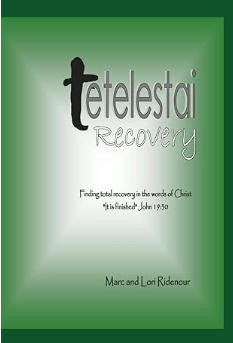








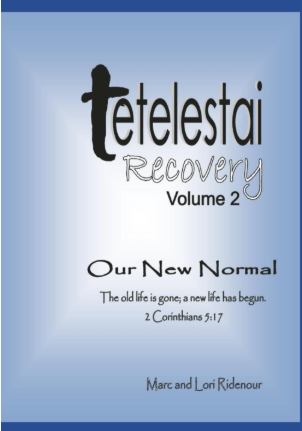

 Finding Total Recovery in the Words of Christ, "It is Finished!"