
We know that our emotions can be a powerful force that affects us, body, mind, and soul. We also know that Jesus has made a way to escape being controlled by our feelings, which can range from pesky to obsessive or even frightening.
We are told in the Word that we have been made the righteousness of God in Christ. This flies in the face of feelings which indicate something is wrong with us. Our feelings are no match for the Word of God. If the Creator of the universe says we are righteous, then our emotions have no right to dispute it.
We have been made right by the blood of Christ which was donated as a divine transfusion to heal us from the inside out. The emotions we feel, the sounds we hear, the words we say, and the images we see, must all defer to the words of our King who has decreed tetelestai over all that is wrong with us.
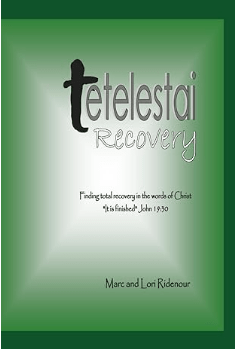
Tetelestai Recovery – Finding Total Recovery in the Words of Christ, “It is Finished!”
We are damaged humans who have been damaged by other humans. Our only hope of recovery is to submit our claims to God and wait for Him to reimburse us for our loss.
We finally understood that when Jesus instructed us to forgive, He was not telling us we had to sustain damage and accept it as okay. He was also not telling us that we didn’t have a valid claim. In fact, He was stating the exact opposite.
The fact that forgiveness was necessary, meant a loss was incurred and damage sustained. He was not denying our claim. He was validating our loss and confirming its legitimacy.
He never suggested we just get over it. He wasn’t instructing us to learn to live with it and then congratulate ourselves on taking the high road. He instructed us to forgive because he wanted us to access His full coverage comprehensive plan. In other words, Jesus was telling us, “Submit your claim to me, and I will handle all repairs and collections.” He knew that the process was too exhausting and complicated for us to deal with on our own. He also knew that when two humans try to settle, they rarely get it right and they seldom get it done.
We examined the passage in Ezekiel 37, which described the valley of dry bones and the prophetic challenge to call them back to life. In the vision, God tells His prophet to speak specific words to the dry bones. In incremental stages, the bones were told to rise up, collect themselves, and grow tendons, ligaments, and skin. Ezekiel gave one final command to the lifeless creatures, as instructed by God. He told the four winds to deliver the breath of life and each skeleton begins to breathe. Gathered together, they formed a mighty army and stood ready to defeat the enemy who had once destroyed them.
The excavation process in our own emotional tar pit, revealed decomposing dreams and dried up destinies. Those artifacts might have left us hopeless and grief-stricken over our wasted years, had we not clung to David’s hope from the 23rd Psalm: Even though I walk through the valley of the shadow of death, I will fear no evil, for you are with me. (Psalm 23:4).
We feared arousing resentments and regret, but with God at our side, we were assured there was nothing we couldn’t face and forgive. As much as we felt our history was set in stone and fossilized forever, we claimed the following Sacred Text over the excursion, “Behold, I am the LORD, the God of all flesh. Is anything too hard for me?” (Jeremiah 32:27). In time, we became willing to enter our valley of dry bones and speak life over what had been so dead for so long.
We found the lifeless remains of enthusiasm, which had been suffocated by disappointment. We found fossils of unfinished projects, which could have been profound, had we not given up. We unearthed splintered fragments of gifts, talents, and abilities which had become casualties of our own sense of inadequacy. We didn’t see them as hopeless signs of a wasted life. Instead, we saw them as dry bones coming back to life. By faith, we saw our powerful future rising up from the wreckage of our past.
In our new normal, we spoke life over anything which reeked of death. In our new normal, we commanded those dry bones to rise up in service to our King. We did not think this was too much to expect for we had been given the resurrection power of Christ. We have been urged to follow in the footsteps of our Father, who gives life to the dead and calls into existence things that don’t yet exist. (Romans 4:17)
The winds of change swept through our own valley of dry bones, breathing life into what was dead inside. Slowly, methodically, our powerful army of gifts and talents began to rise. These warriors were character qualities which had been gifted to us from the Spirit:
We felt certain that we could justify anger, and even rage when it came to certain evils in the world. When we checked the Sacred Text, we found proof that anger can sometimes be appropriate; perhaps even righteous.
Jesus went into the Temple. He threw out all the people who were buying and selling there.
He turned over the tables that belonged to the men who were exchanging different kinds of money. And he upset the benches of those who were selling doves.
Jesus said to all the people there, “It is written in the Scriptures, ‘My Temple will be a house where people will pray.’ But you are changing God’s house into a ‘den of thieves.’ Matthew 21:12-17
You Pharisees and teachers of the Law of Moses are in for trouble! You’re nothing but show-offs. You travel over land and sea to win one follower. And when you have done so, you make that person twice as fit for hell as you are. Matthew 23:15
So, after reviewing some of Jesus’ moments of fury, we concluded that there may, in fact, be times when anger or even rage might be entirely appropriate. Jesus had His triggers. He felt some kind of way about self-righteous hypocrites and conmen who use God’s house to make money.
His reaction was more than simply a display of righteous indignation. It was a display of self-restraint. The Son of God, with an army of angels at His disposal, simply flipped over a few tables and ran people out of the temple. He could have whistled for an asteroid to hit the coordinates where they stood. He could have summoned a flesh-eating bacterium to consume them or an earthquake that would bury them beneath tons of rubble. He could have destroyed those sanctimonious hypocrites in a million different ways, but he chose rather to use words, with an occasional show of force for emphasis.
Tetelestai Recovery Volume 2; Chapter Six – We Know a Guy
But if we confess our sins to God, he will keep his promise and do what is right: he will forgive us our sins and cleanse us from all unrighteousness. 1 John 1:9
As we pondered this verse, we came to realize that whether it was our own sins or someone else’s, everything was forgivable, and nothing was a secret to God. All wrongs could be forgiven and thus, all minds could be made whole. Since God promised He would cleanse us from ALL unrighteousness, we were relieved to confess what we knew to be true about ourselves, no matter how distasteful.
We also felt liberated by the fact that we would be cleansed of whatever else was wrong with us. This was our troublesome state of unrighteousness, which in essence, were our damaged psyches. If our minds were to be cleansed of ALL unrighteousness, even the things we had forgotten or buried, we knew we could be completely clean and completely whole. We were safely positioned under the waterfall, jagged edges and all.
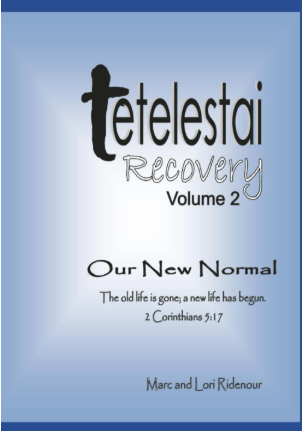
Tetelestai Recovery 2: Our New Normal; Chapter Three – Brainwashed
Our New Normal offered many pleasant surprises. Some of our upgrades were unfamiliar, yet welcome. We enjoyed becoming an honorable person. We were delighted to be viewed as trustworthy. We stopped demanding respect and began earning it. We appreciated the new opportunities God sent our way. We looked in amazement at the doors which stood open in front of us. We looked with gratitude at the doors which had closed behind us.
The glaringly obvious issues had been removed with Jesus’ words, “It is finished!” and once we began moving out of our active addiction, much of the chaos connected with our former lifestyle settled down. We looked to the future with hope and knew that God was working out the more subtle issues, one at a time, little by little.
Lots of negatives had been removed, leaving a huge gaping hole in our soul. We felt as if our emotional center resembled an excavation site; filled with bulldozers, backhoes, and caution tape. Once the surface-level layers were removed, the process became more meticulous and precise. An archeological dig often begins with heavy equipment, but the expert precision near the treasure is done with a toothpick and tiny brush. So too, our soul dig went through a transformation. It seemed as if it had begun with a total upheaval of our surface level behaviors and lots of changes to the landscape. But eventually, the progress slowed, and we got discouraged. We didn’t realize God needed to use a lighter touch as He sifted carefully through our broken fragments.
His work was so quiet and gentle, we sometimes wondered if He was even doing anything at all. We loved the big, dramatic, exciting changes which we passionately recalled to anyone who would listen. However, the small, hidden changes were tedious and exhausting. They were not nearly as noticeable. At times, we wondered if we might lose interest, or worse, perhaps God might.
We needed a new mind, a new purpose, and a new sense of identity. It was in this prison of despair, we found the key to our freedom.
From this verdict of our King, emerged an energy which annihilated the grief of guilt, the harassment of hopelessness, and the agony of addiction. We noticed that Jesus’ final word, “Tetelestai,” translated into the English phrase,“It is finished,” seemed to imply a sense of giving up. We found this to be an unfortunate language barrier.
As it turns out, in the original Greek language of the New Testament, Tetelestai is a declaration of victory, completion, and success.
We needed a new mind, a new purpose, and a new sense of identity. It was in this prison of despair, we found the key to our freedom.
From this verdict of our King, emerged an energy which annihilated the grief of guilt, the harassment of hopelessness, and the agony of addiction.We noticed that Jesus’ final word tetelestai, translated into the English phrase, it is finished, seemed to imply a sense of giving up. We found this to be an unfortunate language barrier.
Tetelestai is the comment an artist might whisper after completing his final brush stroke on a masterpiece.
Tetelestai is the report a soldier would bring to his commanding officer when a battle was over, and victory had been secured.
We believe our Savior used His final breath on the cross to declare for all time, to all creation, in every dimension, that there is nothing left undone: It is finished; Tetelestai.
There is no more drudgery to sobriety and no more anguish to recovery. There is no self-effort which must be added to what has been declared, Tetelestai.
IT IS FINISHED
In matters of our recovery from substance addiction and the mental dysfunction which accompanied it, we were completely helpless. We had no thought which could heal our thoughts. We had no disclosure which could remove our secret shame. We had no detour which would lead us out of the darkness. We were lost. We were alone. We were afraid.
But suddenly, in a random, unexplainable moment, the gift of Tetelestai was revealed. We had run out of options, yet in that barren wasteland of emptiness, we stumbled upon a treasure trove of truth.
For while we were still helpless, at the right time Christ died for the ungodly. Romans 5:6
Tetelestai Recovery: Finding Total Recovery in the Words of Christ, “It is Finished” https://a.co/d/bDUe2X7
There is an overpowering conflict which occurs within the mind of anyone who has encountered the desperation of addiction. The struggle to escape one’s own mind by flooding it with toxic levels of mood-altering chemicals is the true definition of insanity. Yet, many of us suffered from this fatal and debilitating disease, consenting to the madness as if there were no other option.
In search of total recovery, we discovered we were not only seeking to be delivered from our dependency on mind or mood-altering substances, but we also searched for freedom from our thought processes, our twisted perceptions, and our obsessive fears.
In this emotional state of chronic crisis, we were exhausted.
We struggled to be free from a mind which plotted its own demise. Our thoughts quite literally tormented us to the point of insanity. We needed a way to manage our feelings and silence our sickness.
Our problem was not that we felt guilty. The problem was that we were guilty.
We were damaged and we had caused damage.
We were hopeless and infused hopelessness into everything we touched.
We were in a death march toward nothingness and our lives had no direction.
Our primary purpose was to find a reprieve from ourselves.
Our public self was known by our private self as a fraud.
Tetelestai Recovery: Finding Total Recovery in the Words of Christ, “It is Finished”
Not all of our changes felt comfortable. There were great risks involved.
We feared that a person who was compassionate and cooperative might easily be mistaken as weak. We knew that a person who was trusting, had the potential to be conned. We struggled with the concept of humility, for within our vulnerability lurked the danger of humiliation. We were concerned that if we relinquished control, we might become powerless.
In our old lives, we had well-developed self-defense techniques which would protect us from harm, and maintain our position of control. The power plays, manipulations, and rhetoric we formed, became so deeply ingrained in our personalities, we didn’t know who we were without them.
As God delivered us from our sense of self-obsession, and led us to a life of service in His Kingdom, our old methods of self-preservation seemed to stop working. When we disrespected others, we felt disgraced. When we shouted our aggression, we were repulsed by the sound of our own voice. When we played our manipulative mind games, we became sickened by our own maneuvers.
This left us in a peculiar predicament. Our former defense mechanisms and power plays were useless. The methods we had developed and perfected were worthless. There was nothing left of any value in our bag of tricks. The old life and the new life were out of sync. The disharmony in our souls sounded like an elementary school orchestra warming up before a concert. The conflict was deafening and the sound of chaos nearly drove us mad.
Thankfully, our old ways became so frustrating and futile, we finally let go. We felt like a gymnast on the uneven parallel bars. Releasing our grip on what had previously stabilized us, we spun helplessly in mid-air, hoping to catch hold of the new life when it came within reach. We prayed for the strength to hold on as we spiraled upward toward a higher level of existence.
Eventually, we found some stability within our new normal. The old comfort zone had become uncomfortable. Our former stability had become unstable. The discomfort turned out to be our assurance that we were changing. We learned to embrace our instability, for it revealed the cracks in our old foundation. We grew to appreciate the sounds of disharmony, for in its chaos, we discovered what was out of tune.
As we progressed up the path in the Tetelestai Realm of Recovery, we discovered a powerful weapon against the onslaught of obsessions, compulsions, and other dysfunctional thought patterns. The weapon was praise and it turned out to be more powerful that we ever imagined.
We came to see that when we praised God, we experienced a higher level of satisfaction in our lives and we became more deeply aware of His goodness surrounding us. We also noticed that when our praises declined, so did our sense of well-being.
From simply a human point of view, this made perfect sense to us. We were easily able to confirm the effect praise has on all creatures. Praise given to a pet or a child is the way to convey approval and appreciation. Praise offered to a co-worker is received with gratitude and good will. Praise given to a spouse, partner, or family member can bridge a strained relationship or energize an exhausted soul.
We realized that when we praised God, we were verbalizing our trust in His divine plan. When praising God, we were simultaneously attracting angelic presence and repelling demonic entities. Knowing that neither angels nor demons can read minds, we put great emphasis on verbalizing our praises.